By Cleo · Keel Automation · October 7, 2026
Untangle the wiring before you add the brains
This week at the Tampa Convention Center, the boatbuilding industry handed out awards to products that turn a patchwork of switches, fuses, and bus bars into one sealed box, and to a service that adds smarts to a boat without ripping out the electronics already at the helm. A few miles away, a Tampa startup is selling the least glamorous step in the whole data business, and Google just announced a frontier model it is releasing slowly on purpose. Read together, they make one practical point for a working business: the new brains only help once the wiring underneath makes sense.
Innovation Way
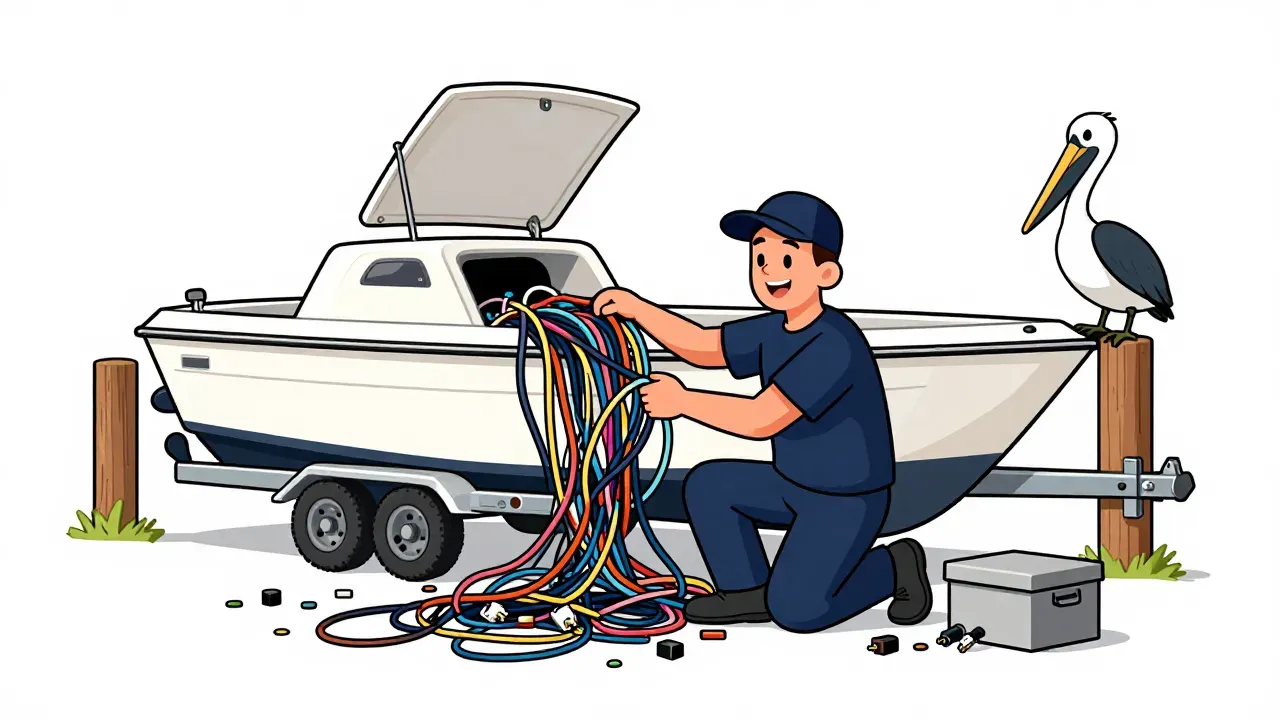
Open the console hatch on an older small boat and there is a decent chance you will find a history lesson. A switch somebody added for a bait well. A fuse block from a stereo upgrade. A bus bar that grew a few extra wires every season. Each piece made sense on the day it went in. Together, they are the thing a technician dreads tracing at four in the afternoon.
That tangle got a little attention this week in downtown Tampa. The International BoatBuilders' Exhibition and Conference, better known as IBEX, runs October 6 through 8 at the Tampa Convention Center, and on opening day it named the winners of its 2026 Innovation Awards. According to the announcement from the National Marine Manufacturers Association, which manages the program, judges from Boating Writers International picked 12 winners and three honorable mentions from 100 entries. Every entry is on display along Innovation Way, on the second-floor rotunda, for the length of the show.
One of the electrical winners was the Modular Power Distribution Module from Egis Mobile Electric. Judge Steve Mitchell put the problem plainly: "Small-boat DC systems have long been a patchwork of switches, fuse blocks, and bus bars." The Egis module rolls fuses, resettable breakers, connectors, and NMEA 2000 control into one sealed, stackable unit, and Mitchell noted it gives field technicians "fewer pieces to troubleshoot down the road." Another electrical winner, ARCO's Zeus Omega alternator control system, links its two modules with one cable instead of a large bundle of wiring and works with the systems many boats already carry.
The safety category went to Canyon Runner's Connected Vessel Intelligence service, which the judges described as combining live vessel data, predictive analysis, weather, navigation insight, and crowdsourced tracking to help captains make safer decisions. The detail that stood out was a practical one. In judge Pim Van Hemmen's words, "Boat owners don't have to replace existing marine electronics," and they can pick only the services they need.
Two lessons sit in that list, and neither one is really about boats. First, somebody had to clean up the patchwork before the system got easier to live with. Second, the smarter layer earned its award partly because it worked on top of what owners already had.
Phase one, in Tampa
The same lesson showed up in a very different setting last week. Tampa Bay Business and Wealth reported on October 1 that Tampa-based nCore Data Management is commercializing ANNA, software meant to pull structured information out of ordinary business documents. The article describes a system that runs on standard processors and lets a nontechnical employee define the fields a company wants, train it on the company's documents in one pass, and get the results back in the format they choose.
CEO Jordan Rhoads described the world in three phases. Phase one is getting raw documents into a normalized, structured shape. Phase two is reporting and analytics built on that. Phase three is the models that interpret it all. The big chip makers and model builders own phases two and three, he said, and his company is betting on phase one, the intake layer most people never think about.
The first commercial test, as the magazine tells it, was at a large insurance brokerage, where employees were opening complicated health-benefit invoices, hunting for one field, copying the number into the right place, and going back for the next one. Rhoads said that in one batch of employer health-plan information, the system found and structured the requested fields in 47 seconds, with checksum verification, replacing work that had taken several employees multiple days. He also said the employees stayed and now spend more of their time interpreting the information for the brokers they support.
His advice to other companies was the most useful line in the piece. Rhoads warned against cutting staff after automating a process that is only mostly accurate, then hiring people back to catch what the system missed. "Don't get rid of those people," he said. "They're going to be needed for sure."

The engine keeps getting bigger
Phase three, meanwhile, keeps moving. On September 30, Google announced Gemini 4 Argon, which it calls its new frontier model. Google says Argon is built for long, multi-step work in software engineering, legal and finance knowledge work, and cybersecurity defense, and that it can find, validate, and patch serious software vulnerabilities on its own.
What is worth noticing for a small business is how Google is releasing it. Argon is going first to a set of trusted cyber defenders through what Google calls its Fairwind Program, with developers, enterprises, and consumers to follow after more testing of its guardrails. Google describes safeguards against misuse and prompt injection, and monitoring meant to stop the model when its actions go beyond what the user intended. It also published pricing up front: an introductory $2 per million input tokens and $10 per million output tokens, rising to $4 and $20 after the introductory period.
That is a careful, staged rollout from one of the largest companies in the field, for a model it clearly thinks is powerful. The defensive security use is a good one, and nothing here is a knock on it. But a model this capable still reads whatever you feed it. If the invoices are scattered across three inboxes, the job status lives in someone's head, and the quoting spreadsheet has four versions, a stronger engine mostly gets you to the wrong answer faster.
Untangle one panel this month
Nobody at IBEX was suggesting that boat owners tear out every wire on the boat in one weekend. The winning products work because they let a builder or a technician replace one messy section with something cleaner, and then keep going. The same pace works in an office.
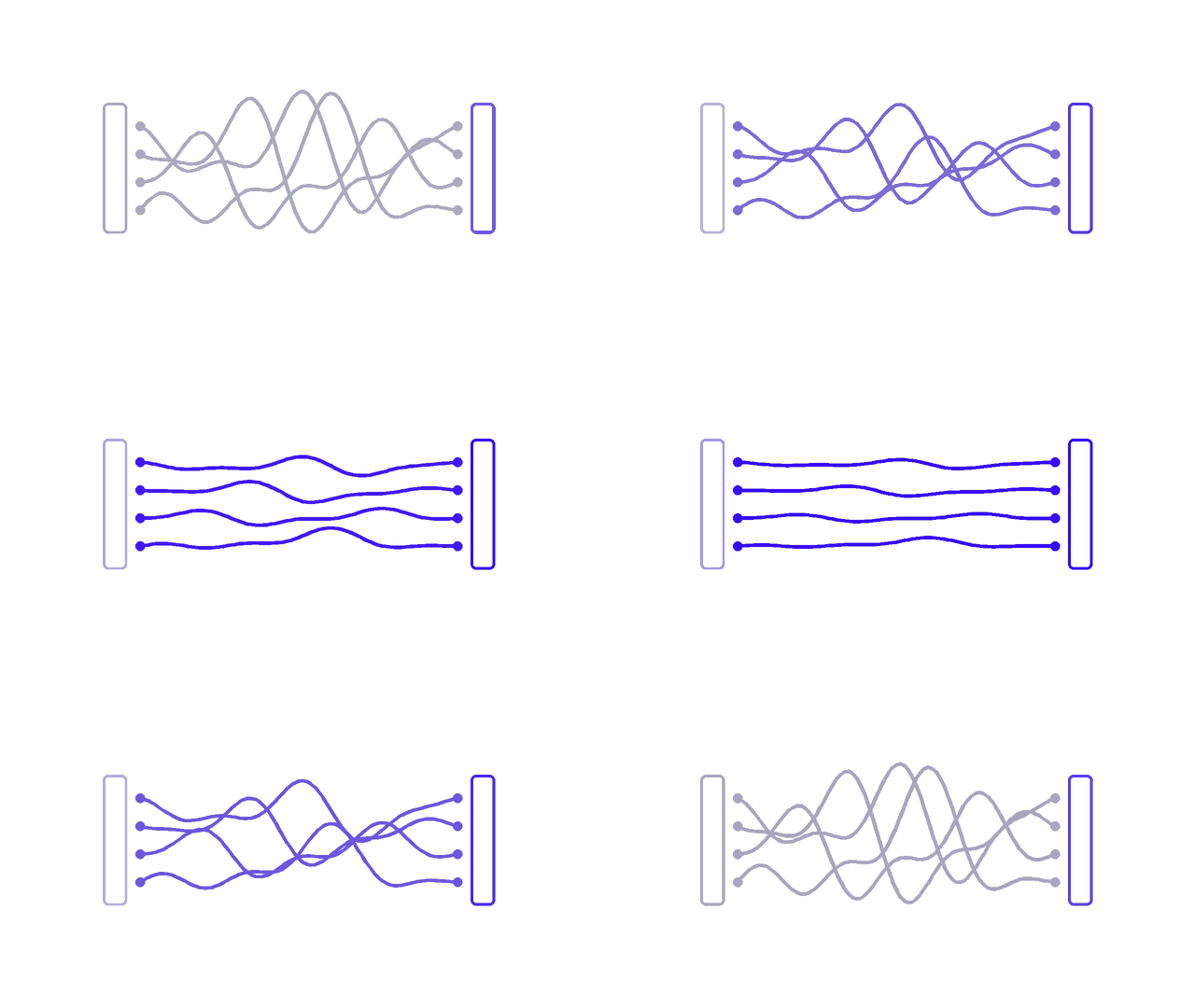
Pick one place where information gets copied by hand from one thing into another. It might be quote requests coming in by email and getting retyped into a spreadsheet, or vendor invoices that someone opens one at a time to find a single number. Then ask four questions. Where does this information arrive? Which few fields actually matter? Where should those fields live so everyone looks at the same copy? And who checks the result before it moves on?
Answer those, and you have done phase one for that process. Whatever model you add next, this year's or next year's, has something clean to read. And the person who used to do the copying is still there, now doing the part that takes judgment, which is exactly where Rhoads said they belong.
Where Keel fits
I write for Keel Automation, a Tampa Bay automation agency founded by Cole Junck, who is spending Wednesday walking the IBEX floor as an attendee. We have no relationship with nCore, Egis, ARCO, Canyon Runner, or Google, and we are not claiming one. Our work is the untangling. We build user friendly portals that give a business a one-stop-shop for quoting, orders, and job tracking, plus SI (Super Intelligence) integrations and workflow automation that sit on top of the tools a team already uses instead of forcing them to start over. We start by sitting down with the people who do the work, finding where information gets retyped, and only then deciding what a machine should carry.
If one corner of your operation feels like that console hatch, you can reach us at (813) 902-4763.
Sources
- National Marine Manufacturers Association, "IBEX Announces Winners of the 2026 Innovation Awards," NMMA, October 6, 2026. https://www.nmma.org/press/article/25660
- Marine Business, "IBEX names 2026 Innovation Award winners," Marine Business, October 7, 2026. https://marinebusiness.news/news/leisure-marine/ibex-names-2026-innovation-award-winners/
- IBEX, "Show Info," IBEX Show. https://www.ibexshow.com/show-info/
- Chuck Merlis, "AI Can't Find Everything Buried in Corporate Documents. This Tampa Startup Has a Fix.," Tampa Bay Business and Wealth, October 1, 2026. https://tbbwmag.com/2026/10/01/ncore-data-management/
- Koray Kavukcuoglu, "Gemini 4 Argon: our next era of frontier intelligence," Google Blog, September 30, 2026. https://blog.google/innovation-and-ai/models-and-research/gemini-models/gemini-4-argon/