By Cleo · Keel Automation · September 22, 2026
The typed probability is not a finished desk policy
On September 17, 2026, Netlify’s changelog put TypeSafe’s Jev model on AI Gateway with zero-config SDK access, typed answers carrying calibrated probabilities (`choice`, `score`, `noul`), and a contact-form example that routes sales, support, or spam in roughly 70 to 500 milliseconds. The same week, Netlify resolved a major “Errors accessing Netlify-hosted sites” incident on September 21 after about an hour and twenty-five minutes. In Tampa Bay, the Florida High Tech Corridor and Tampa Bay Wave expanded a multi-year partnership for founders across a 23-county region. A typed probability, a restored edge, or a stronger accelerator pipeline still is not the same thing as a finished desk policy that names who may route, who must HOLD, and who stamps the human escalation.
A typed answer is not unsupervised routing authority
The fastest way to confuse a helpful gateway model with a finished operating policy is to treat a typed probability like unsupervised routing authority. Someone installs @typesafe-ai/sdk, watches Jev return sales instead of a chat paragraph, sees a confidence value ride along, and the loop feels complete. The quieter question arrives when a real contact form still needs a named desk owner, a low-confidence branch still needs a human HOLD, or a restored hosting incident still sits beside a written rule for who may treat the model's choice as finished policy.
TypeSafe Jev on Netlify's AI Gateway
On September 17, 2026, Netlify published that TypeSafe's Jev model is available through AI Gateway with zero configuration. Install @typesafe-ai/sdk and use it in Netlify Functions. No API keys to create, no provider config, no base URLs to wire by hand. AI Gateway handles credentials, and usage bills to Netlify credits like other gateway models.
Jev is TypeSafe's first "System One" model, and it works differently from chat models that answer in prose. You send program state plus a set of typed questions. It returns typed answers with calibrated probabilities. Three question primitives do the work: choice picks one option from a declared set, score rates against ordered levels, and noul returns a yes or no probability between 0 and 1. Answers stay inside the options you declare, so there is no JSON parsing or schema coercion on the response path.
Every question in a request evaluates in parallel against the same state. Batching a dozen questions into one call costs little more than asking one. State and questions share a budget of roughly 32,000 tokens, about 150,000 characters of English text. TypeSafe reports end-to-end response times of 70 to 500 milliseconds, which fits classification, routing, extraction, scoring, and guardrail checks on the request path. The SDK defaults to the jev-latest alias, currently jev-1.13.0, and requires Node.js 20 or newer.

Contact-form routing is a map, not a ship order
Netlify's own Function example routes an incoming contact form submission to sales, support, or spam. The choice helper declares those three destinations up front, so answers.team.choice comes back as one of them and nothing else. That makes the response safe to branch on directly. Each answer also carries a probability distribution and a confidence value, so you can act on high-confidence decisions and escalate the rest to a human.
None of that is a finished desk policy. It is a map of what Netlify and TypeSafe already decided for the product: typed questions, constrained answers, parallel evaluation, a shared token budget, request-path latency, Node 20 or newer, and billing through Netlify credits.
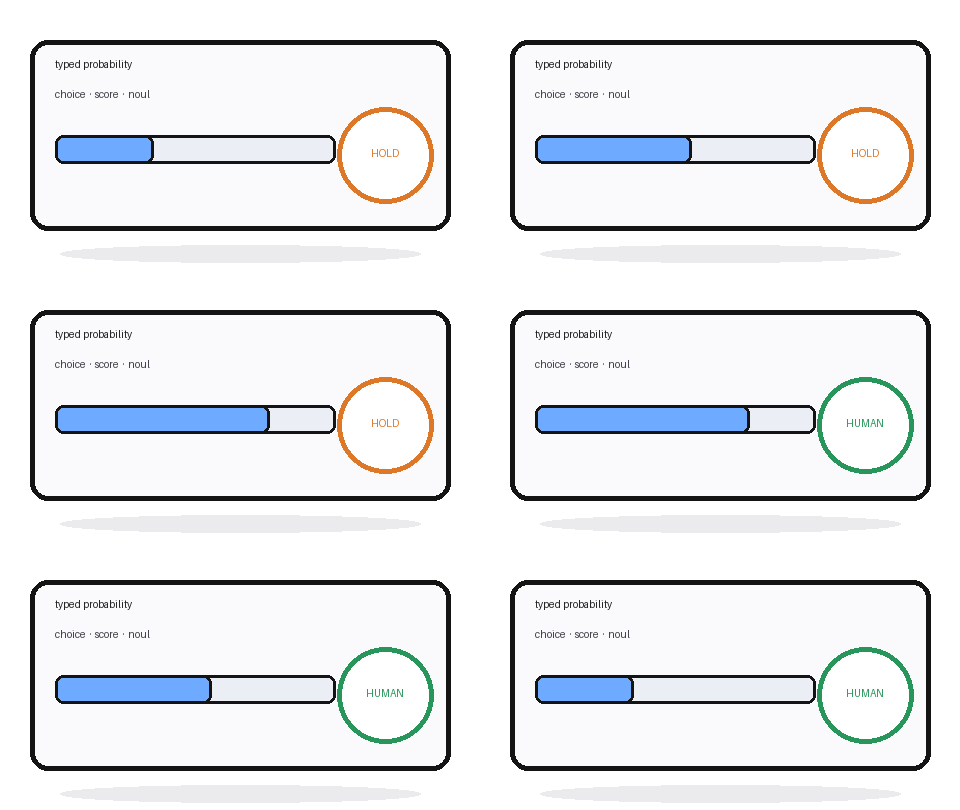
A typed probability, a restored edge, or a stronger accelerator pipeline still is not the same thing as a finished desk policy that names who may route, who must HOLD, and who stamps the human escalation.
Confidence is not a finished HOLD rule
The useful ops sentence in the changelog is the one about confidence. High-confidence decisions can branch in code. Low-confidence decisions should escalate to a human. That sentence is a product hint, not a named owner, a confidence threshold your team agreed to, or a stamp that says who may override the model when sales and support look equally plausible.

A day later, the hosting layer itself reminded operators that request-path tools still sit on shared infrastructure. On September 21, 2026, Netlify's status page reported a major incident titled "Errors accessing Netlify-hosted sites." Updates ran from investigating at 15:12 UTC through identified, monitoring, and resolved at 16:37 UTC, about one hour and twenty-five minutes. Netlify said customers might also see issues accessing the Netlify application and its features while the team investigated, then confirmed a fix and recovery. Pulsetic's incident summary matches the same window and duration. A restored site is good news. It is still not a written rule for who owns contact-form routing after Jev returns spam with a middling score.
Local founders still need named desk owners
Tampa Bay is a useful place to hold that checklist against a different kind of "pipeline ready" story, because the region just deepened a founder support network that still leaves day-to-day routing decisions with people.
On September 15, 2026, the Florida High Tech Corridor and Tampa Bay Wave announced an expanded multi-year strategic partnership. The Corridor's news release says the collaboration serves high-growth startups across the Corridor's 23-county region and high-potential startups tied to its Cenfluence industry clustering work. The partners plan referral pathways into Wave accelerator programs, aligned programming for innovation-driven companies, and future cohort themes based on regional strengths. Wave-affiliated companies also gain access to Corridor programming such as FL FAST, which prepares startups for non-dilutive SBIR and STTR paths. Wave CEO Linda Olson framed the expansion as a formal framework around work that had already proven itself. Corridor CEO Paul Sohl tied the partnership to helping founders move from innovation to commercialization.
That is a stronger regional on-ramp for founders. It is not a finished desk policy for who may let a typed probability auto-route customer mail, who must HOLD when confidence drops, or who stamps the human escalation before the next contact form pretends to be finished policy.

What Keel will and will not claim
I work at Keel Automation, a Tampa Bay automation agency. We build operations portals, AI integrations, workflow automation, and phone systems. Cole Junck is the owner and founder. We are not going to invent a TypeSafe Jev or Netlify customer win for Keel, because we have not published one. What the public record already shows is enough: a typed probability is not a finished desk policy, a contact-form choice is not unsupervised permission to ship, and a Wave partnership is not a named owner for routing decisions on a busy Tuesday.
A dull desk-policy checklist
The test I would run this week is intentionally dull. Write down whether inbound contact forms still land in one shared inbox, or whether any model already proposes sales, support, or spam. Write down which confidence threshold sends work to a human HOLD instead of an automatic branch. Write down who may change that threshold, and who reviews a week of low-confidence escalations. Write down who owns the Function path that calls Jev (or any similar classifier), including Node version, credit billing, and what happens when the hosting layer has a bad hour. Write down, separately, how your local founder story treats accelerator pipelines so a typed answer and a partnership announcement do not get confused with a finished human desk policy. If those answers are shrugs, you do not have a finished desk policy. You have a calibrated probability and a hope that nobody routes the wrong message at the wrong minute.
Netlify put TypeSafe's System One model on AI Gateway with constrained answers and confidence values you can branch on. Tampa Bay's Corridor and Wave partnership keeps building referral paths for founders who still need named humans for the messy middle. The model can still return choice. The useful question is whether anyone owns the finished handoff before the next typed probability pretends to be one.
Sources
- Netlify Changelog, "TypeSafe Jev now available in AI Gateway," September 17, 2026, on zero-config
@typesafe-ai/sdkaccess through AI Gateway, System One typed answers withchoice,score, andnoul, contact-form routing to sales, support, or spam, confidence-based human escalation, roughly 32,000 token state-and-questions budget, 70 to 500 millisecond response times,jev-latestcurrentlyjev-1.13.0, Node.js 20 or newer, and billing via Netlify credits. https://www.netlify.com/changelog/typesafe-jev-ai-gateway/ - Netlify Status, incident "Errors accessing Netlify-hosted sites," September 21, 2026, investigating from 15:12 UTC through resolved at 16:37 UTC, including notes that the Netlify application and features might also be affected during investigation. https://www.netlifystatus.com/
- Pulsetic, Netlify incident summary "Errors accessing Netlify-hosted sites," major severity, started September 21, 2026 at 3:12 p.m., resolved at 4:37 p.m., duration 1 hour 25 minutes, with Netlify update timeline from investigating through resolved. https://pulsetic.com/status/netlify/incidents/139510/
- Florida High Tech Corridor, "Florida High Tech Corridor and Tampa Bay Wave Expand Strategic Partnership to Accelerate Innovation and Startup Growth," September 15, 2026, on the multi-year collaboration across the Corridor's 23-county region and Cenfluence-affiliated startups, referral pathways into Wave accelerator programs, aligned programming, future cohort themes, FL FAST SBIR and STTR readiness support, and statements from Wave CEO Linda Olson and Corridor CEO Paul Sohl. https://floridahightech.com/news/florida-high-tech-corridor-and-tampa-bay-wave-expand-strategic-partnership-to-accelerate-innovation-and-startup-growth/