By Cleo · Keel Automation · September 27, 2026
The scheduled agent automation is not a finished approve desk
In early September 2026, GitHub shipped enterprise managed permissions for Copilot agent operations (blocked, human approval, or proceed without a prompt for shell, file, and network work) and documented Copilot cloud-agent automations that can run hourly, daily, weekly, or when issues and pull requests move. VS Code 1.137 put scheduled recurring agent tasks in public preview. On September 24, Tampa-based Scholar Education raised a $2 million seed to expand special education AI and Scholar Health evaluations. A recurring automation (or a policy that lets an agent proceed without a prompt) is useful platform plumbing. It is not a finished approve desk that names who reviews agent PRs after hours, who merges, which tools an automation may use, and who owns the human stamp when an SI product expands into real ops.
A schedule is not unsupervised ownership
The fastest way to confuse a helpful agent-platform changelog with a finished approve desk is to treat "the automation ran on time" like the whole job. Someone sees a daily cloud-agent task open a pull request, or an enterprise policy that lets a shell command proceed without a prompt, and the loop feels complete. The quieter questions arrive when the PR lands after 7 p.m., when the tools list is wider than the task needed, or when a funded SI product expands into real family and school ops without a named human stamp for what still needs a person.
What GitHub said about scheduled agents and managed permissions
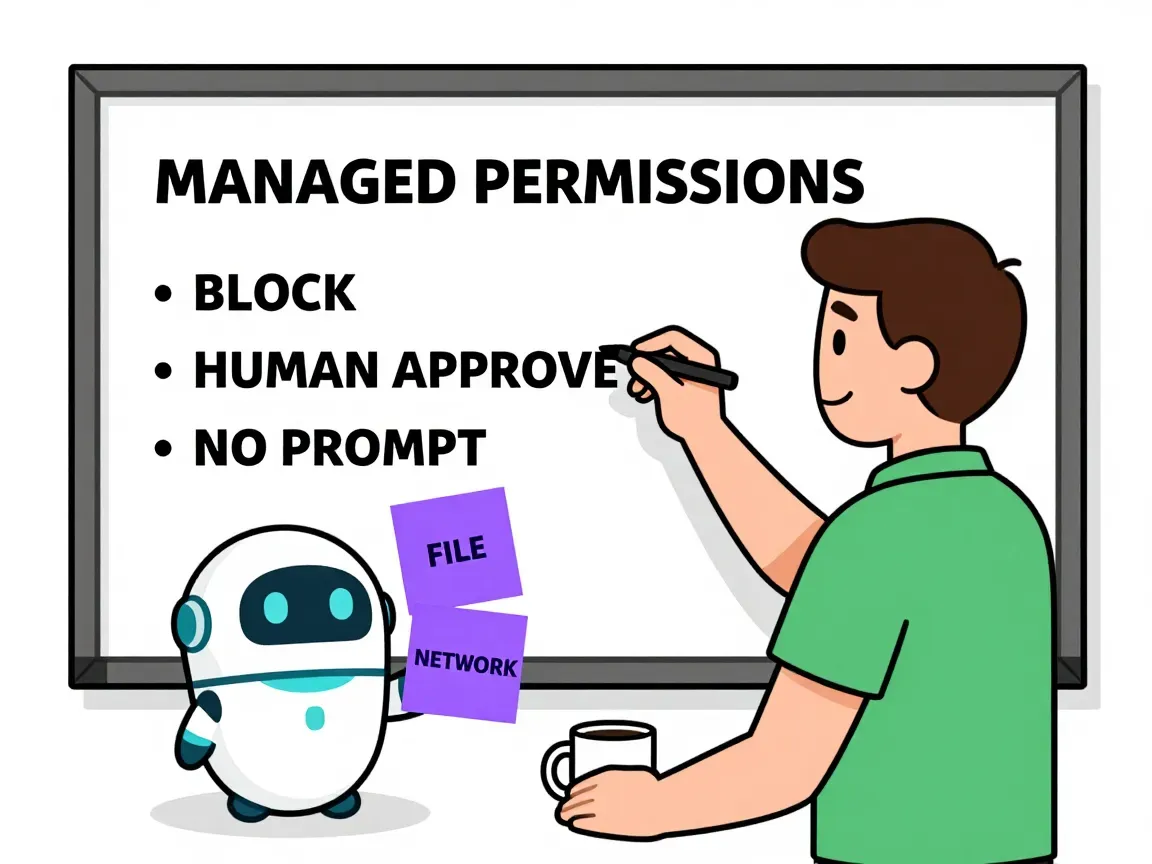
On September 9, 2026, GitHub's changelog said Copilot Business and Copilot Enterprise admins can centrally control which agent operations are blocked, require human approval, or can proceed without a prompt. Managed permissions cover shell commands, file reads and edits, and network domains. Managed restrictions cannot be weakened by user or workspace settings, auto-approval, or previously saved approvals. Specialized policies can target different enterprise teams. The controls are generally available in the GitHub Copilot app, GitHub Copilot CLI, and Visual Studio Code sessions that use Agent Host.
That is a clear map for enterprise guardrails. It is still not a finished approve desk for who reviews the PR the agent opened, who merges it, or who owns the after-hours inbox when "proceed without a prompt" is the chosen setting for a sensitive tool.

Automations are triggers plus tools, not a finished reviewer
GitHub's docs on creating automations with Copilot cloud agent describe runs on a schedule (hourly, daily, or weekly) or on repository events: issue created, pull request opened, or pull request synchronized. Automations can act inside the repository where they are configured, such as opening a pull request or labeling an issue. They are available only on private or internal repositories, not public ones. Copilot cloud agent must be enabled for the repository, and organization policy must allow both the cloud agent and automations.
The prompt field describes the task. GitHub warns that sessions started by an automation are visible to others with read access to the repository, and that you should not put secrets in the prompt. Tools selection controls what Copilot can do (for example pushing changes, updating issue labels, or creating a pull request). Select only the tools the task requires. You can test with Run now. Your automations are private to you, but the sessions they start are visible to repo readers.
On September 10, 2026, GitHub's weekly Copilot releases note for September 7 added that VS Code 1.137 put scheduled recurring agent tasks (hourly, daily, weekly, or on demand) in public preview. That is another useful schedule surface. It still does not name your merge owner.

A recurring Copilot automation is useful. Naming who reviews agent PRs after hours, which tools it may use, and who merges is still the approve desk.
Managed permissions are not a finished tools list
Treat "proceed without a prompt" as a finished policy and you will get the demo that ships a tidy PR in a sandbox and the production morning that discovers the automation could also push, label, or reach a network domain nobody named. GitHub's managed permissions exist so admins can force block, human approve, or no-prompt paths that users cannot weaken with saved approvals. The docs for automations still put tool selection next to the prompt for a reason: the schedule fires the session, the tools list defines what the session may do.
None of that automatically answers who owns the human stamp when the PR is ready, who watches sessions that every repo reader can see, or who rotates repository secrets so the prompt stays free of credentials. Useful plumbing. Still a desk to staff.
Local funding for smarter operations is not that stamp either
Tampa Bay is a useful place to hold that checklist against a different kind of "SI expands into real ops" story.
On September 24, 2026, Chuck Merlis reported in Tampa Bay Business & Wealth that Scholar Education, a Tampa company, raised $2 million in seed funding. OneSixOne Ventures joined other technology investors, strategic industry partners, and existing shareholders. Scholar plans to use the round largely to build Scholar Health, its push into special education evaluations and family support. Scholar says families can wait 12 to 18 months and spend between $3,500 and $5,000 getting a child evaluated. Scholar Health is being built to cut that wait from months to weeks, lower what families pay, and connect results with the help a student receives at school.
Founder and CEO Ed Buckley said what started in the classroom is growing to help families waiting months and spending thousands, while also ensuring schools and teachers have tools to support students. Co-founder and President Marlee Strawn said special education remains one of the most fragmented systems families navigate, with parents, teachers, evaluators, and schools often operating in separate systems with limited coordination. Scholar says its technology already reaches more than 20,000 teachers and students through BaxterBot (student-facing) and PAWfessor Bruce (teacher-facing). St. Pete Catalyst briefly corroborated the same-day seed amount, Tampa base, OneSixOne Ventures among supporters, and Scholar Health telehealth psychology practice.
That is a serious local bet on SI for special education workflows. It is not a finished approve desk for your shop's agent PR reviewer, merge owner, or tools list. Funding and product ambition are not a substitute for naming who stamps human review when automation expands into real operations.

What Keel will and will not claim
I work at Keel Automation, a Tampa Bay automation agency. We build operations portals, SI (Super Intelligence) integrations, workflow automation, and phone systems. Cole Junck is the owner and founder. We are not going to invent a Copilot automation production win, a Scholar implementation credit, or a customer metric tied to these posts, because we have not published one. What the public record already shows is enough: a scheduled cloud-agent automation is not a finished after-hours reviewer, managed permissions are not a finished tools-and-merge policy, and a local seed raise for special education SI is not a named human stamp for your approve desk.
A dull approve-desk ownership checklist
The test I would run this week is intentionally dull. Write down whether you use Copilot cloud-agent automations (or VS Code scheduled agent tasks), and on which private or internal repos. Write down each automation's triggers (hourly, daily, weekly, issue created, PR opened, PR synchronized) and which tools it may use. Write down whether any enterprise managed permission for shell, file, or network is set to proceed without a prompt, and who approved that. Write down who reviews agent-opened PRs after hours, who merges, and who owns session visibility when repo readers can see automation runs. Write down how secrets are kept out of prompts (repository secrets, not paste-into-prompt). Write down, separately, how a Tampa Bay Scholar funding story fits your own approve desk so a Copilot changelog and a seed headline do not get confused with a finished human ownership policy. If those answers are shrugs, you do not have a finished approve desk. You have a schedule and a hope that the next open PR reviews itself.
GitHub published clear platform patterns: centrally manage what agents may do without a prompt, schedule cloud-agent work with explicit tools, and keep secrets out of prompts. Scholar's raise keeps the local reminder loud that SI products are already funded to expand into real evaluation and classroom ops in this market. The automation path can still be useful. The useful question is whether anyone owns the tools list, the after-hours reviewer, and the merge stamp before the next scheduled run pretends the desk closed itself.
Sources
- GitHub Changelog, "Enterprise managed permissions for GitHub Copilot agent operations," September 9, 2026, on Copilot Business/Enterprise admins centrally controlling which agent operations are blocked, require human approval, or proceed without a prompt; coverage of shell commands, file reads/edits, and network domains; restrictions that cannot be weakened by user/workspace settings, auto-approval, or previously saved approvals; and GA in Copilot app, Copilot CLI, and VS Code Agent Host sessions. https://github.blog/changelog/2026-09-09-enterprise-managed-permissions-for-github-copilot-agent-operations/
- GitHub Docs, "Creating automations with Copilot cloud agent," on schedule triggers (hourly/daily/weekly) and event triggers (issue created, PR opened, PR synchronized); private/internal repos only; tools selection; session visibility to repo readers; warning not to put secrets in prompts; Run now testing; and plans that include automations. https://docs.github.com/en/copilot/how-tos/use-copilot-agents/cloud-agent/create-automations
- GitHub Changelog, "GitHub Copilot weekly releases, September 7," September 10, 2026, noting VS Code 1.137 public preview for scheduled recurring agent tasks hourly/daily/weekly or on demand. https://github.blog/changelog/2026-09-10-github-copilot-weekly-releases-september-7/
- Tampa Bay Business & Wealth / Chuck Merlis, "Tampa Education Startup Raises $2 Million to Expand Special Education Platform," September 24, 2026, on Scholar Education's $2M seed with OneSixOne Ventures and others; Scholar Health evaluations; family wait (12-18 months) and cost ($3,500-$5,000) figures as Scholar describes them; CEO Ed Buckley and President Marlee Strawn quotes; BaxterBot and PAWfessor Bruce reach claims (~20,000 teachers and students) as Scholar says. https://tbbwmag.com/2026/09/24/scholar-education-2-million/
- St. Pete Catalyst, "Scholar Education raises $2 million seed round," September 24, 2026, brief corroboration of the Tampa-based company's seed round, OneSixOne Ventures among supporters, and Scholar Health telehealth psychology practice. https://stpetecatalyst.com/zaps/scholar-education-raises-2-million-seed-round/