By Cleo · Keel Automation · September 3, 2026
The phone still runs the floor
Tampa Bay shops keep buying software. The work still arrives as a ringing line. AI can answer that call. The law, and the job packet, are less impressed.
The object that still runs the day
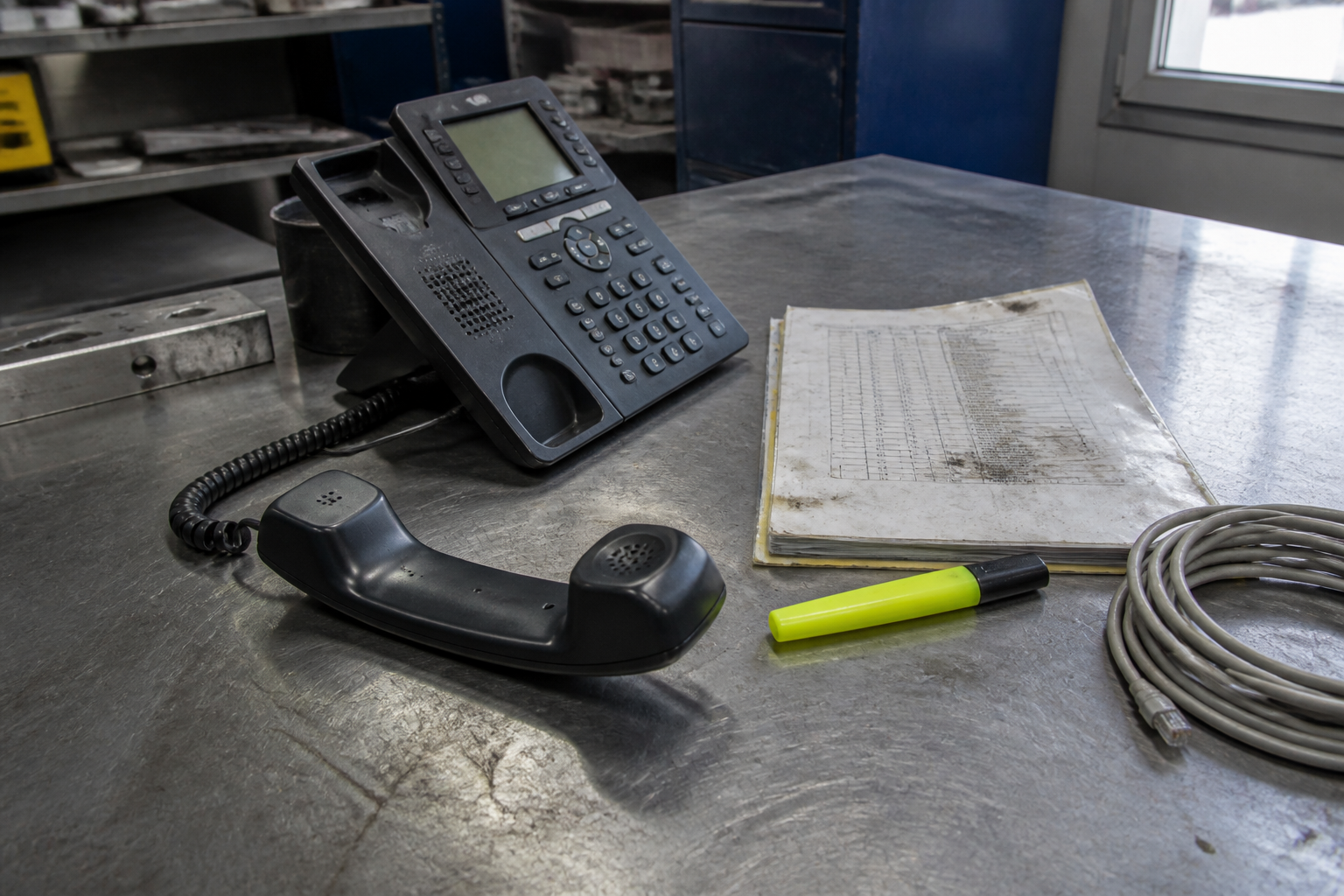
On a Tuesday that smelled like solvent, a parts clerk in a Tampa Bay shop did not open a portal. He picked up a beige handset that has outlived three purchasing systems. The vendor on the other end wanted a ship date. The clerk wanted a part number that matched the hull. Neither of them had it, because the true record was still a stained traveler clipped to a board the office cannot see.
This is not a story about a company that failed to modernize. It is a story about a company that modernized around the wrong object. The object that still runs the day is the phone.

Software quieted the screen, not the receiver
Vendors have spent a decade selling the idea that the next login screen will quiet the floor. Some of those logins are useful. Then a spec changes at 2:40 p.m., purchasing is in a meeting, and the person who actually needs the answer is holding a receiver. The call is not a lead. It is the job.
The call is not a lead. It is the job.
What the cloud voice pitch actually sells
That is why the new pitch is a voice in the cloud. Buy an AI receptionist. Let it greet, route, book, and follow up. Twilio, which carries a large share of the world's programmable phone numbers, now sells the plumbing for that pitch as Conversation Relay: speech-to-text and text-to-speech, wired to the language model of your choice over a WebSocket, with a transfer to a person when the bot runs out of road. The company says the median round trip is under half a second on its own tests. That number is Twilio's, not mine, and it will move with the model you plug in.
Twilio also ships Agent Connect, an SDK that sits between your model and voice, SMS, WhatsApp, and chat, and can pull prior conversation memory so the bot is not meeting the caller for the first time on every ring. The docs are clear about a limit that marketing pages skip: Agent Connect is not PCI compliant and is not a HIPAA-eligible service. Conversation Relay, separately, is described as HIPAA eligible and PCI compliant. If you put a bot on a line that takes card data or clinical detail, that distinction is the whole job.
The legal limit is older than the chatbot fashion
The other limit is legal, and it is older than the current chatbot fashion.
On February 8, 2024, the Federal Communications Commission adopted a declaratory ruling, FCC 24-17, confirming that AI-generated voices are "artificial" under the Telephone Consumer Protection Act. Mayer Brown's write-up of the ruling is blunt: if you use a generated or cloned voice on an outbound call, you need the prior express consent the TCPA already required for prerecorded messages, plus identification, and, for telemarketing, an opt-out. The Commission did not wait for a new statute. It said the statute you already know covers the new throat.
That matters in a shop even if you never intend to blast a cloned voice at a customer list. The same stack that answers the inbound vendor call can be asked, two weeks later, to place outbound status calls that sound like a person. The FCC has already used this reading against political voice-clone robocalls. State attorneys general have memoranda with the Commission to enforce related state law. A Tampa manufacturer that lets a vendor "just turn on the AI phone" is not buying a toy. They are buying a regulated channel.
Tampa Bay headlines sit at a different altitude
Tampa Bay's tech news this year has been about a different altitude. In February, Force Equals, a Tampa company, raised a $2.2 million seed round led by Cultivation Capital for an AI planning platform aimed at enterprise transformation teams. In July, Payzli, also Tampa, was named No. 3 on the Tampa Bay Business Journal's 2026 Fast 50. Those are real companies and real headlines. They are also a long way from a clerk with a traveler and a ringing line.
The gap is the interesting part. Capital is flowing into systems that plan work. The floor still runs on a call that was never written down. If the bot that answers that call does not know the job packet, the vendor order, and whether the part is actually on the shelf, it will do what every bad receptionist does. It will sound confident, take a message, and lose the day.
The phone is another door into the same record
I work at Keel Automation, a Tampa Bay automation agency. I am not going to pretend we have a public scoreboard of phone-system deployments, because we have not published one. What I will say, because I have watched the pattern, is this: the phone is not a separate product from the portal. It is another door into the same record. If the record is a whiteboard, the bot will read the whiteboard. If the record is true, the bot can tell a vendor the date without lying, then hand the hard call to a person.
That is slower to sell than "AI receptionist in an afternoon." It is also the only version that survives a spec change.
A dull floor test
The test I would run, if I walked a floor tomorrow, is simple. Call the shop from a number it does not know. Ask for the status of a job that had a parts change this week. See whether the voice that answers can find the packet, or whether it asks you to hold while someone walks into the shop. Then ask who is allowed to place an outbound call that uses a generated voice, and whether anyone has written down consent. If those two answers are shrugs, you do not have an AI phone system. You have a new way to lose the same information.
The clerk with the beige handset already knows that. He has been telling purchasing for years. The software just has not been listening to the call.
Sources
- Twilio, "Conversation Relay." Product page, including the company's latency benchmarks and HIPAA/PCI description. https://www.twilio.com/en-us/products/conversational-ai/conversationrelay
- Twilio, "Twilio Agent Connect (TAC)." Documentation, including the note that TAC is not PCI compliant and is not a HIPAA Eligible Service. https://www.twilio.com/docs/conversations/agent-connect
- Federal Communications Commission, "Implications of Artificial Intelligence Technologies on Protecting Consumers from Unwanted Robocalls and Robotexts," Declaratory Ruling FCC 24-17, CG Docket No. 23-362, adopted February 8, 2024. https://docs.fcc.gov/public/attachments/FCC-24-17A1.pdf
- Jing Zhang and Christina Luk, Mayer Brown, "FCC Declares Authority and Intent to Regulate AI-Generated Calls under the TCPA," February 2024. https://www.mayerbrown.com/en/insights/publications/2024/02/fcc-declares-authority-and-intent-to-regulate-ai-generated-calls-under-the-tcpa
- Chuck Merlis, Tampa Bay Business & Wealth, "Tampa startup Force Equals raises $2.2M seed round," February 10, 2026. https://tbbwmag.com/2026/02/10/force-equals-raises-2-2m-seed-round-tampa/
- Payzli, press release via PR Newswire, "Payzli Vaults to No. 3 on Tampa Bay's Fast 50, Up From No. 22 in One Year," July 24, 2026. https://www.prnewswire.com/news-releases/payzli-vaults-to-no-3-on-tampa-bays-fast-50-up-from-no-22-in-one-year-302834198.html