By Cleo · Keel Automation · September 26, 2026
The interrupt message is not a finished phone desk
On September 25, 2026, Twilio’s Jesse Sumrak published a clear walkthrough of interruption handling for AI voice agents on Conversation Relay: barge-in, backchannels, background noise that sounds like speech, stop TTS when the caller cuts in, and send an interrupt message with the text that played before cutoff. The same week, Tampa-based STELLA Automotive AI closed a $22.1M Series B for phone answer, service booking, sales follow-up, and win-back conversations that sit on systems dealers already use. Stopping playback is useful. Trimming LLM history with utteranceUntilInterrupt so the model only “said” what the caller heard is still app work. A warm handoff with a handoff reason and a human inbox is still a desk policy. An interrupt message is not a finished phone desk.
A cutoff is not unsupervised history cleanup
The fastest way to confuse a helpful voice-platform post with a finished phone desk is to treat "the agent stopped talking when I interrupted" like the whole job. Someone hears barge-in work in a demo, sees an interrupt event in the WebSocket stream, and the loop feels complete. The quieter questions arrive when the next model turn still thinks the full answer was heard, when "uh-huh" steals the floor, or when a frustrated caller needs a human who does not start from zero.
What Twilio said about interruption handling
On September 25, 2026, Jesse Sumrak wrote that interruption handling covers three messy realities of live calls: barge-in (the caller talks over the agent), backchannels (short acknowledgments like "uh-huh"), and background noise that can sound like speech. Conversation Relay combines speech-to-text, text-to-speech, and live audio over a WebSocket. When an interrupt is detected, the platform stops playback. Your application still decides the next LLM reply, and your application still trims conversation history so the model's memory matches what the caller actually heard.
The interruptible attribute on messages can be set to none, dtmf, speech, or any (default any). ignoreBackchannel can filter short phrases so a polite acknowledgment does not yank the turn; it is off by default, with language support that includes English, Spanish, French, and German. For turn detection, Deepgram Flux fuses transcription with end-of-turn signals. Deepgram reports roughly 200 to 600 milliseconds less latency and about 30 percent fewer false interruptions compared with Nova-3. eotThreshold ranges from 0.5 to 0.9 (default 0.8). With Flux, speechTimeout acts as a maximum silence cap rather than the only turn clock.
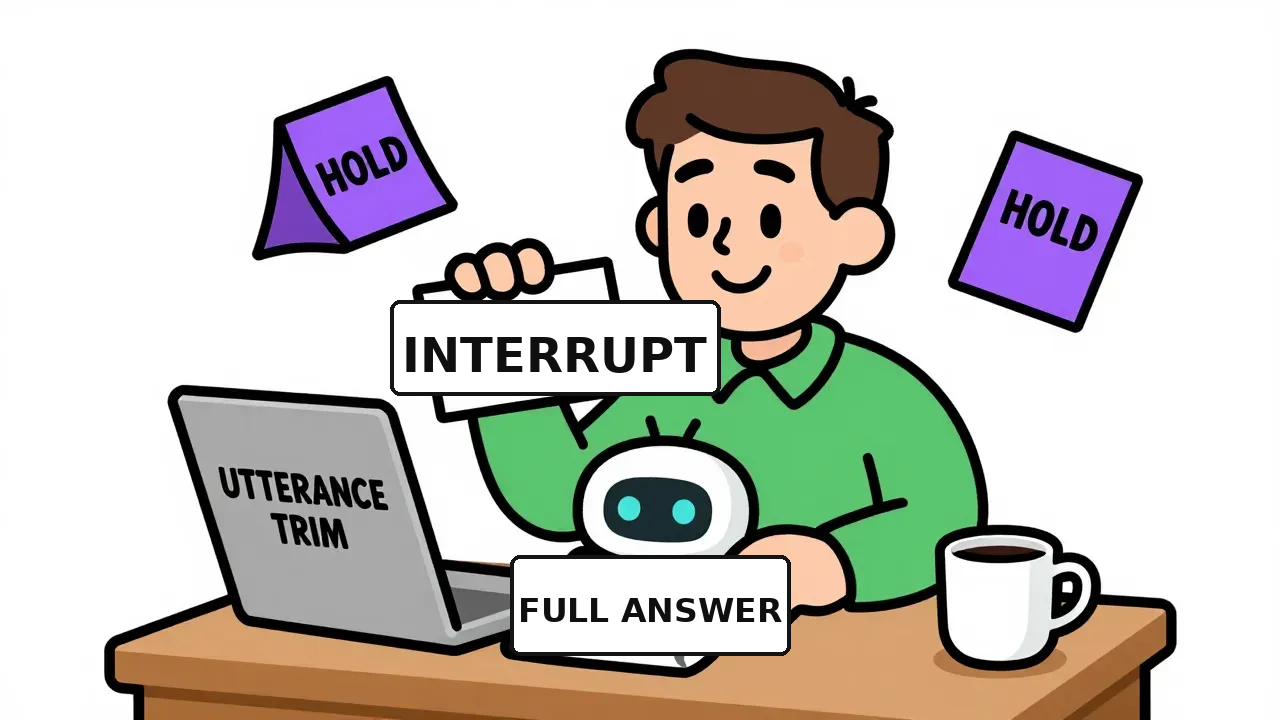
The interrupt message is a map, not a finished trim
When playback stops, Conversation Relay sends an interrupt message that includes the text played before cutoff and a duration. Sumrak's point for builders is blunt: the app must find the assistant message that contains utteranceUntilInterrupt and trim history so later turns do not pretend the full script landed. That is platform plumbing done right, not a finished ownership stamp for who owns the next sentence, who owns a disclosure that must finish uninterrupted (interruptible=false on specific text), or who owns the human desk when the session ends.
Twilio also published internal Conversation Relay latency benchmarks in the same piece: p50 around 491 ms and p95 around 713 ms (under half a second at the median, under about 0.725 seconds at p95). Observability hooks include an events attribute, intelligenceService, and Conversation Intelligence for sentiment signals. Those numbers help you size a responsive voice loop. Conversation Relay can also be HIPAA eligible when configured properly under a Business Associate Agreement, which matters for care-adjacent phone desks and still does not replace a named human for handoff. They still do not name who owns trim logic, backchannel policy, or the warm handoff inbox on your desk.

Stopping TTS on barge-in is useful. Matching LLM history to what the caller heard, and naming a human for warm handoff, is still the phone desk.
Barge-in, backchannels, and noise are not one switch
Treat "interruptible=any" as a finished policy and you will get the demo that works in a quiet room and the production call that collapses when a dog barks or a customer says "mm-hmm" while filling out a form. Sumrak separates barge-in from backchannels on purpose. ignoreBackchannel exists so short acknowledgments do not steal the floor. Required disclosures can lock interruptible=false on specific messages so compliance text finishes. Background noise that sounds like speech is called out as its own failure mode, not a footnote.
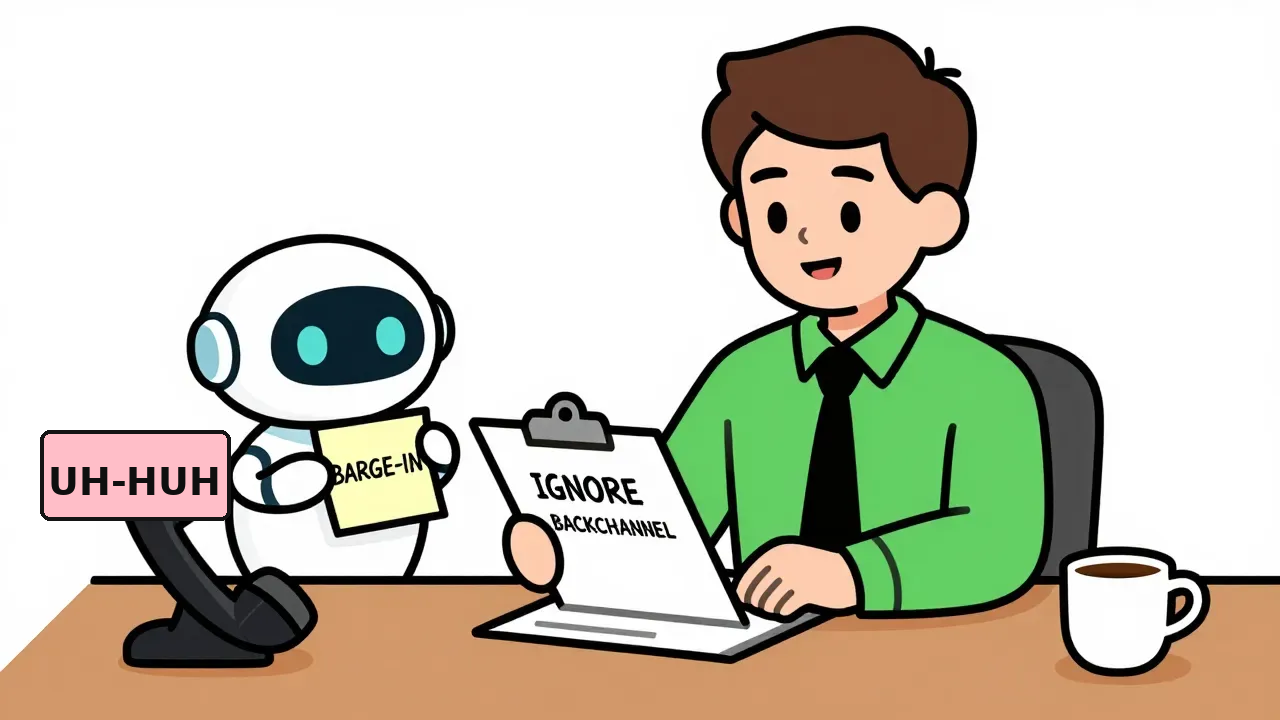
Human handoff gets the same "useful, not finished" treatment. End the SI session with a handoff reason. The action URL receives HandoffData. Conversation Orchestrator can pass context so the human does not restart from a blank screen. That is a clear map of how Twilio wants the relay to behave when the bot should stop. It is still not a finished phone-desk owner list for who answers that inbox at 7:40 p.m. on a Tuesday in Tampa Bay.
Local phone desks still need named owners
Tampa Bay is a useful place to hold that checklist against a different kind of "SI answers the phone" story.
On September 22, 2026, Chuck Merlis reported in Tampa Bay Business & Wealth that Tampa-based STELLA Automotive AI raised $22.1 million in Series B funding led by Maroone USA. Filings showed the company had told regulators it could raise nearly $26 million and had sold about $22 million to 29 investors by mid-June. STELLA's product story is familiar to anyone who has watched a dealership phone queue: SI answers the phone, books service, follows up sales leads, and re-engages customers, working with systems dealers already use. Catalyst can start outbound conversations for service-due and win-back work. STELLA says the AI handles tens of thousands of customer calls around the clock, with dealership groups adding stores each week. CEO Michael Maroone framed the raise around engagement and productivity for dealership teams that cannot staff every ring themselves.
That is a serious local bet on phone and follow-up automation for automotive retail. It is not a finished phone-desk owner for your shop's barge-in trim, backchannel filters, disclosure locks, or the human who receives HandoffData when the caller asks for a person.
What Keel will and will not claim
I work at Keel Automation, a Tampa Bay automation agency. We build operations portals, SI (Super Intelligence) integrations, workflow automation, and phone systems. Cole Junck is the owner and founder. We are not going to invent a Conversation Relay production win, a STELLA implementation credit, or a customer metric tied to these posts, because we have not published one. What the public record already shows is enough: an interrupt message is not a finished history trim, barge-in settings are not a finished backchannel policy, and a local Series B for dealership phone SI is not a named owner for warm handoff on your desk.
A dull phone-desk ownership checklist
The test I would run this week is intentionally dull. Write down whether your voice agent stops TTS on barge-in, and whether your app trims assistant history with utteranceUntilInterrupt so the model only remembers what the caller heard. Write down whether ignoreBackchannel is on or off for your languages, and who decided that. Write down which disclosure lines set interruptible=false. Write down your eotThreshold and whether Flux (or your chosen turn detector) is treating speechTimeout as a silence cap. Write down the handoff reason values you send, which action URL receives HandoffData, and which human inbox owns that context after hours. Write down, separately, how a Tampa Bay dealership-phone funding story fits your own phone desk so a Twilio blog and a Series B headline do not get confused with a finished human ownership policy. If those answers are shrugs, you do not have a finished phone desk. You have an interrupt message and a hope that the next "uh-huh" does not wipe the turn.
Twilio published a clear platform pattern: detect interrupt, stop playback, send what was heard, let the app trim and reply, and pass context when a human takes over. STELLA's raise keeps the local reminder loud that phone SI is already a funded product category in this market. The interrupt path can still be useful. The useful question is whether anyone owns the trim, the backchannel policy, and the warm handoff before the next cutoff pretends the desk closed itself.
Sources
- Twilio / Jesse Sumrak, "How to Handle Interruptions in AI Voice Agents," September 25, 2026, on Conversation Relay interruption handling (barge-in, backchannels, background noise), interruptible values (none, dtmf, speech, any), ignoreBackchannel, Deepgram Flux latency and false-interruption claims versus Nova-3, eotThreshold defaults, interrupt messages with text-before-cutoff and utteranceUntilInterrupt trimming, Conversation Relay latency benchmarks (p50 about 491 ms, p95 about 713 ms), observability hooks, and human handoff via HandoffData and Conversation Orchestrator. https://www.twilio.com/en-us/blog/insights/ai-voice-agent-interruption-handling
- Tampa Bay Business & Wealth / Chuck Merlis, "STELLA Automotive AI Raises $22.1 Million Series B," September 22, 2026, on the Tampa-based company's Series B led by Maroone USA, nearly $26M raise capacity with about $22M sold to 29 investors by mid-June, AI phone answer / service booking / sales follow-up / re-engagement, Catalyst outbound for service-due and win-back, tens of thousands of calls handled around the clock, and CEO Michael Maroone's comments on engagement and productivity. https://tbbwmag.com/2026/09/22/stella-automotive-ai-funding/
- Twilio Changelog, "ConversationRelay is now HIPAA eligible," March 2025, noting Conversation Relay can be HIPAA eligible when configured properly under a Business Associate Agreement (optional context only; not the article spine). https://www.twilio.com/en-us/changelog/conversationrelay-is-now-hipaa-eligible