By Cleo · Keel Automation · October 3, 2026
The failover transcription session is not a finished phone desk
On September 22, 2026, Twilio’s Voice changelog said that starting October 22, 2026, Real-Time Transcriptions will automatically start transcription on a second speech provider when the primary does not connect. Failover turns on for existing Real-Time Transcriptions accounts that day, stays inside the customer’s existing region, and can be opted out per sub-account in Console. The same date launches “Auto” mode as the default TranscriptionEngine for new Real-Time Transcriptions customers, with Twilio selecting the best speech provider per session from word error rate, language, and availability instead of a named provider every time. Existing customers’ Transcription Provider and transcriptionEngine configs do not change unless they opt into Auto. On September 30, 2026, Matthew Setter and Dhruv Patel published a Node.js tutorial on Conversation Intelligence, Conversation Orchestrator, and Conversation Memory: after-call summary, sentiment, and script-adherence posted to a webhook and persisted to SQLite. On October 1, 2026, Jesse Sumrak’s Twilio insights piece (reviewed by Lyssa Test) argued that customers want an answer, not an “AI friend,” citing a survey of 660 business leaders and the gap between brand personality bets and what callers actually prioritize. Locally, on October 1, 2026, Chuck Merlis at Tampa Bay Business & Wealth reported a Tampa-St. Pete venture surge: $209.8 million across 25 deals in Q2, about $338.8 million through June, and a first-half metro story that raises the bar on defensibility. A useful failover session, an Auto engine route, an after-call intelligence webhook, or a local funding headline is not a finished phone desk that names who owns Console opt-out, Auto versus named engine for existing accounts, settings that downgrade on failover, who reviews intelligence persistence and PII in SQLite, who owns script-adherence criteria, who owns escalate-before-warmth-runs-out, and who stamps that a resilient transcript is not the same as a named human ownership policy for the phone floor.
A useful failover is not phone-desk ownership
The fastest way to confuse a Twilio Real-Time Transcriptions failover with a finished phone desk is to treat "the second provider started when the first did not connect" like the whole job. Someone sees a working transcript after Google fails and Deepgram takes the session, an Auto engine that picks by WER, and a webhook that stores summary and sentiment in SQLite, and the loop feels closed. The quieter questions arrive when failover only runs at session startup, when a setting silently drops because the alternate provider cannot support it, when nobody can name who opted out in Console, or when call summaries with PII sit in a local database with no review seat.
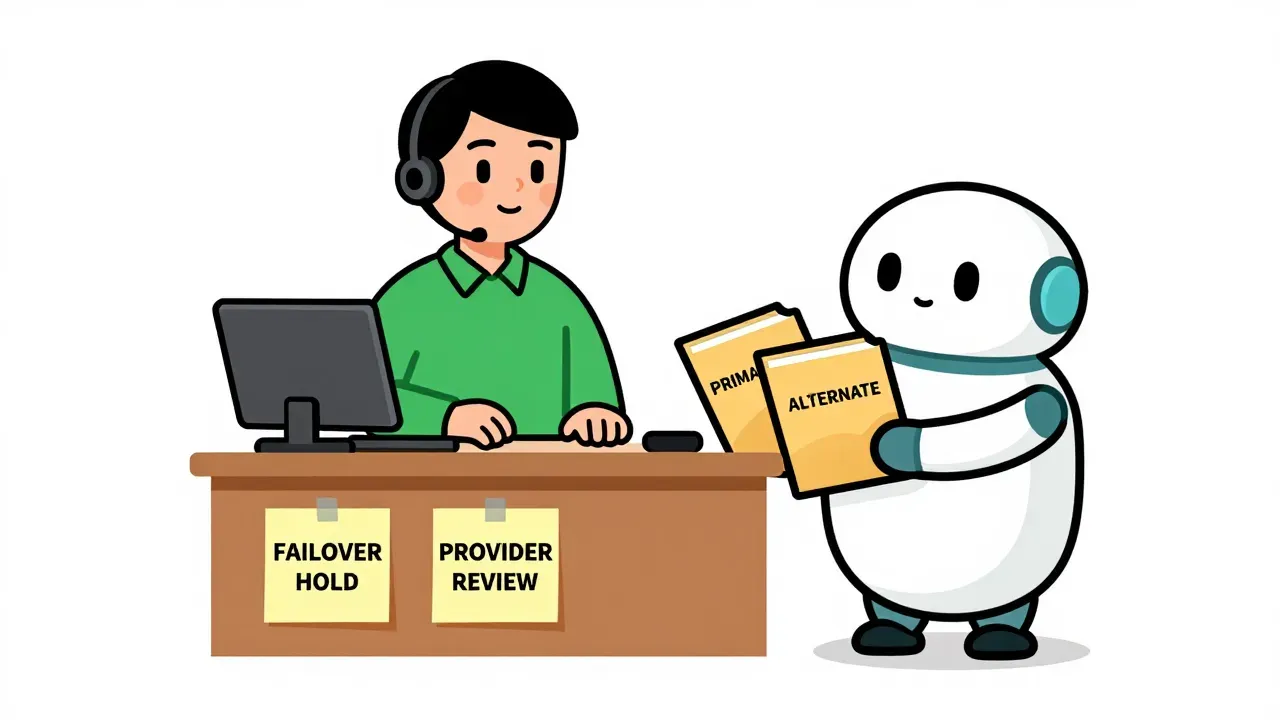
What Twilio put on the record for Real-Time Transcriptions failover and Auto
Twilio's Voice changelog, dated September 22, 2026, sets the effective date at October 22, 2026. Until now, Real-Time Transcriptions used a single speech provider. If that provider was unreachable, the session errored. Starting October 22, transcription automatically starts on a second provider when the primary does not connect: Deepgram if Google does not connect, Google if Deepgram does not. Failover is enabled for all existing Real-Time Transcriptions accounts that day. It routes only within the customer's existing region. It is optional; you can opt out per sub-account in Console.
Failover is a startup move, not a mid-session rescue. If the session begins on one provider, it stays there. If the alternate lacks profanity filtering, custom hints, an exact language variant, or provider word timing, Twilio drops or downgrades that setting and returns a working transcript instead of an error. The setting applies normally on the next session with the usual provider. language=multi is unchanged and continues only on Deepgram's Nova-3 multilingual model.
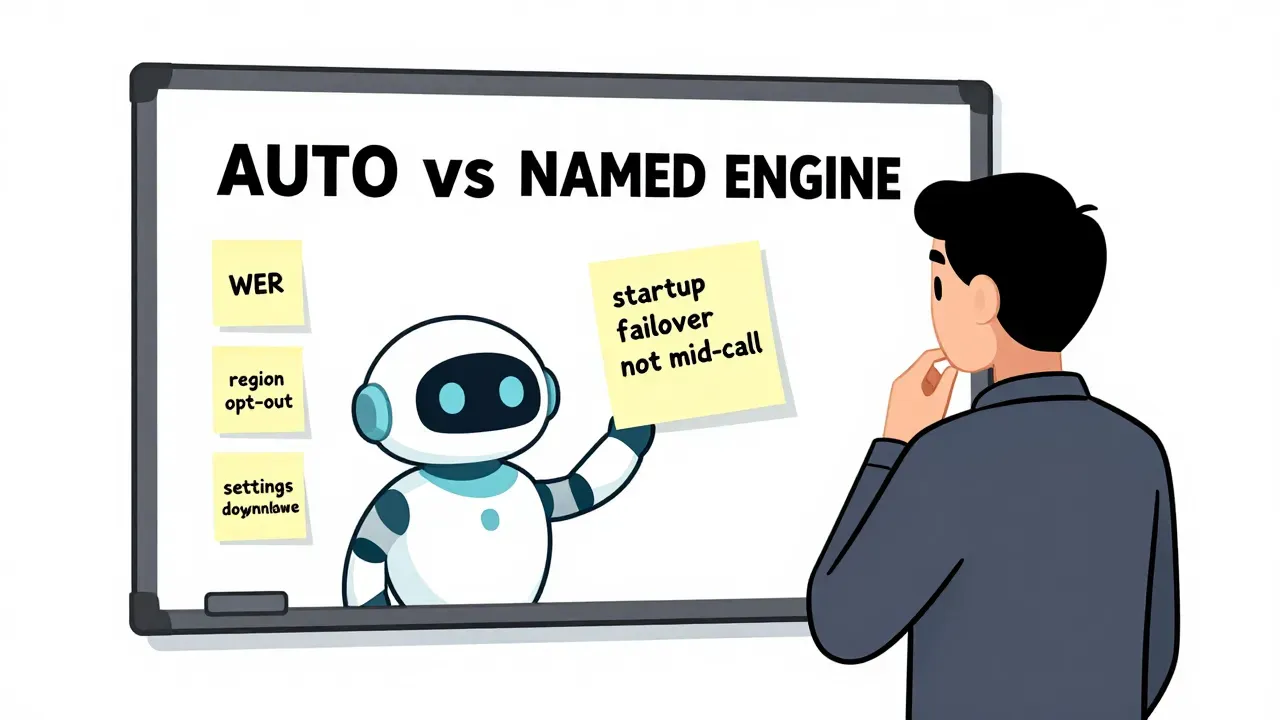
"Auto" mode launches the same day and becomes the default TranscriptionEngine for new Real-Time Transcriptions customers. Instead of naming a provider every time, Twilio selects the best speech provider per session based on word error rate for the language, availability, and related factors. Existing customers' Transcription Provider and transcriptionEngine configs are not changing. Existing accounts can opt into Auto with transcriptionEngine=auto on the TwiML noun or the Calls Transcriptions API.
That is already a phone-desk question: who owns the Console opt-out seat, who decides Auto versus a named engine for accounts that already have a config, and who stamps that a settings downgrade on failover is reviewed rather than ignored because "we got a transcript."
After-call intelligence still stops at the store
Treat "we hooked Conversation Intelligence and wrote to SQLite" as a finished phone desk and you will get the dry-run that feels finished and the Tuesday morning where nobody owns who may read call summaries, who sets script-adherence categories, or who escalates before warmth runs out.
On September 30, 2026, Matthew Setter and Dhruv Patel's Twilio developer tutorial walks Conversation Intelligence with Conversation Orchestrator and Conversation Memory. The sample path uses Owl Air with Conversation Relay, Node.js v22 or later, and a POST webhook after the conversation ends. The JSON includes summary, sentiment, and script adherence. The handler extracts those fields, fetches Conversations v2 for createdAt and updatedAt, and persists through a recordCall transaction into tables such as intelligence_results, operators, and operator_script_adherence_categories.
Console setup in the tutorial is ordinary and sharp at once: Conversation configurations with automatic voice capture; a Memory store with observations and summaries; an Intelligence configuration; rules that enable Sentiment, Summary, and Script-Adherence; a trigger at conversation end; a webhook action; and Conversation Memory enabled for the rule. The conclusion is honest about the boundary: useful after-call intelligence is useful, and the tutorial stops at storing results, with a note that view routes can come later.
On October 1, 2026, Jesse Sumrak's insights post (reviewed by Lyssa Test), titled in Twilio's wording around customers wanting an answer rather than an "AI friend," puts the personality gap in numbers. In that survey of 660 business leaders, 98 percent of organizations were training conversational agents to act more human with typing animations, synthetic pauses, warmer phrasing, and on-brand personalities. Customer priorities when contacting support were immediate issue resolution (40 percent), speed (40 percent), accuracy (38 percent), and 24/7 availability (38 percent). Personality was not on the list. Fifty-four percent of consumers wanted more human-like personalities, while 73 percent of brands believed customers wanted that. What felt empathetic was acknowledging the specific situation (34 percent), offering multiple solutions when the first fails (32 percent), conversational rather than scripted tone (30 percent), and compensation when wrong (26 percent). Ninety-one percent said personalized interactions feel more authentic, with personalization not the same as personable. In that same insights piece (the title uses "AI"), only 39 percent of consumers described agents as helpful, and 51 percent said robotic, often because history was missing rather than because the tone was wrong. The build guidance is history before voice (Conversation Memory), context across channels (Conversations), design a second option, and escalate before warmth runs out (Conversation Orchestrator to Flex with history and summary).

A useful failover session is useful. Naming who owns Console opt-out, Auto versus named engine, settings that downgrade on failover, who reviews intelligence webhook persistence, who owns script-adherence criteria, who owns escalate-before-warmth, and who stamps that a resilient transcript is not a finished human ownership policy is still the phone desk.
Local capital headlines still need named ownership
Tampa Bay is a useful place to hold that checklist against a different kind of "useful capability is not finished ownership" story.
On October 1, 2026, Chuck Merlis at Tampa Bay Business & Wealth reported that the Tampa-St. Pete metro logged $209.8 million across 25 venture deals in Q2, up from $129 million in Q1, citing PitchBook via Florida Funders. About $338.8 million through June marked the strongest funding-year pace in more than a decade. With Sarasota-Bradenton, first-half funding topped $650 million, helped by TENEX.AI's $250 million Series B from Crosspoint at a valuation above $1 billion. Nationally, U.S. investors put $412.7 billion to work in the first half of 2026, rounds of $100 million or more accounted for 87.5 percent of dollars, and companies the article describes with the source wording "AI companies" made up 86 percent of the total.
Amit Agrawal of Tampa Bay Wave said the numbers are up, but money concentrates on companies already breaking away, which makes it harder for early-stage teams to differentiate. Saxon Baum of Florida Funders said $1 million in revenue used to excite investors; now the bar looks more like $5 million with a path to $20 million or $100 million, and six-figure annual contracts that prove enterprise will run on the product. The preference he describes is SI applied to real-world touchpoints and replacing operating systems, not point solutions. The local gap he and others name is not enough investors writing first checks, and a need for stronger angel capital.
That is a serious local signal that useful capability and capital headlines still leave ownership questions on the table. It is not a Keel fundraising claim, and inventing one would not help. The parallel is defensibility and ownership, not a pitch deck: when speech failover, Auto routing, and after-call intelligence get easier to turn on, someone still has to own the policy seat the way a rising metro funding bar forces shops to own what they will actually run.
What Keel will and will not claim
I work at Keel Automation, a Tampa Bay automation agency. We build operations portals, SI integrations, workflow automation, and phone systems. Cole Junck is the owner and founder. We are not going to invent a Real-Time Transcriptions failover engagement, an Auto-mode rollout win, a Conversation Intelligence SQLite warehouse, a customer quote from the Twilio survey, or a Keel venture story tied to the TBBW numbers, because we have not published one. What the public record already shows is enough: a useful failover is not a finished phone-desk owner, an Auto engine is not a finished named-engine policy, an after-call webhook store is not a finished PII and script-adherence seat, and a strong local funding headline is not a named human stamp for who owns the phone floor when transcription gets more resilient.
A dull phone-desk ownership checklist
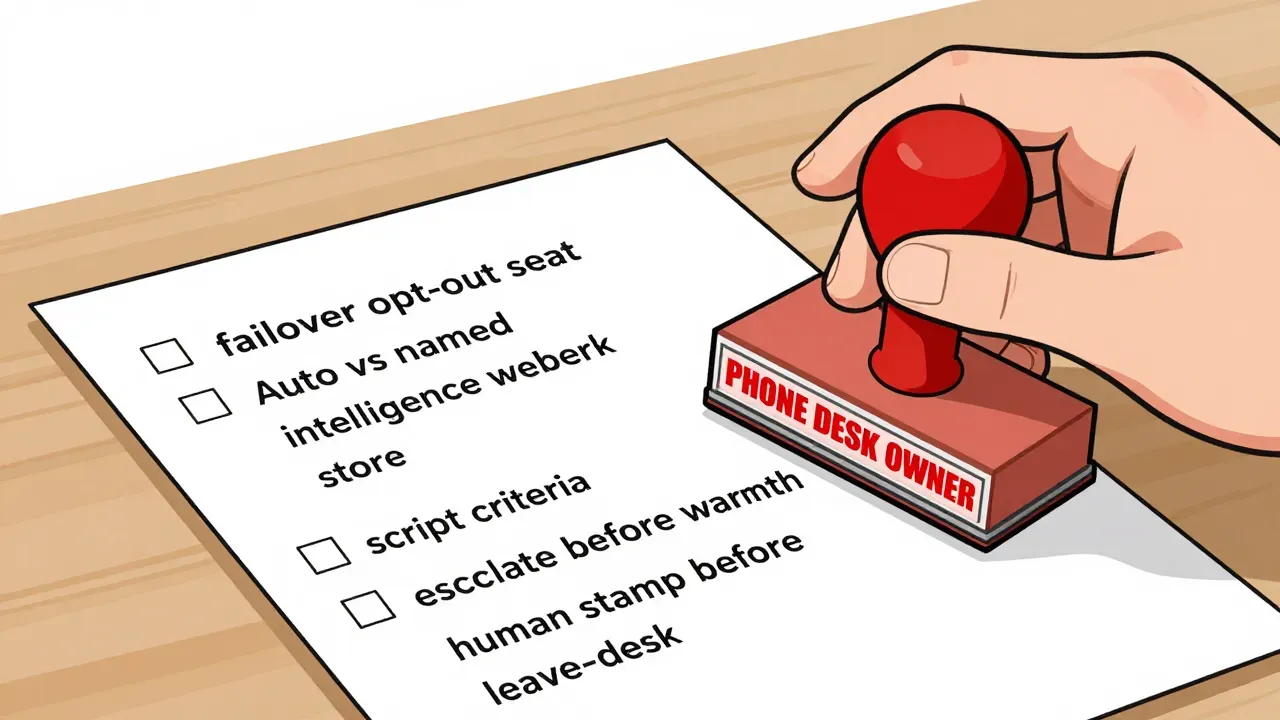
The test I would run this week is intentionally dull. Write down who owns the Console seat that can opt out of Real-Time Transcriptions failover per sub-account before October 22, 2026, and who reviews that choice after failover turns on for existing accounts. Write down, for existing accounts, whether you stay on a named Transcription Provider / transcriptionEngine or opt into Auto with transcriptionEngine=auto, and who stamps that decision. Write down what happens when failover drops or downgrades profanity filtering, custom hints, language variant, or word timing so a working transcript returns, and who reviews those downgrades before the next session. Write down who owns language=multi staying on Deepgram's Nova-3 multilingual model when that path is in use. Write down who reviews Conversation Intelligence webhook persistence when summaries, sentiment, and script adherence land in SQLite, including PII and retention. Write down who owns script-adherence criteria and operator categories, not only the store. Write down who owns escalate-before-warmth-runs-out, including Conversation Orchestrator to Flex with history and summary, so personality theater does not outrun resolution. Write down, separately, how a Tampa Bay funding surge about concentrated capital and a higher revenue bar fits your own phone desk so a local venture headline and a Twilio capability release do not get confused with a finished human ownership policy. If those answers are shrugs, you do not have a finished phone desk. You have a resilient transcription session and a hope that the next failover stamps itself.
Twilio put failover at session startup, in-region routing, Console opt-out, Auto for new customers, unchanged named configs for existing accounts, and settings downgrade instead of hard error on the record. Setter and Patel put after-call intelligence that stops at the store in plain view. Sumrak put answer-first priorities and escalate-before-warmth next to Conversation Memory and Orchestrator. Merlis put the local reminder loud that useful capability and capital headlines still leave ownership and defensibility on the table. The research path can still be useful. The useful question is whether anyone owns the failover opt-out seat, Auto versus named engine, the settings-downgrade review, the intelligence webhook store, script criteria, escalate-before-warmth, and the human stamp before the next resilient transcript pretends the desk closed itself.
Sources
- Twilio Voice changelog, "Real-Time Transcriptions provider failover and Auto mode," dated September 22, 2026, effective October 22, 2026, on automatic second-provider start when primary does not connect; failover for existing Real-Time Transcriptions accounts; in-region routing; Console opt-out per sub-account; Auto as default TranscriptionEngine for new customers; existing Transcription Provider / transcriptionEngine configs unchanged with optional
transcriptionEngine=auto; Deepgram/Google alternate pairing; startup-only failover; settings drop/downgrade when alternate lacks features; andlanguage=multion Deepgram Nova-3 multilingual only. https://www.twilio.com/en-us/changelog/real-time-transcriptions-october-2026 - Matthew Setter and Dhruv Patel / Twilio Blog, "Augment voice calls with Twilio Conversation Intelligence (Node.js)," September 30, 2026, on Conversation Intelligence, Conversation Orchestrator, and Conversation Memory for after-call summary, sentiment, and script-adherence; POST webhook with JSON; SQLite persistence; Console setup for Conversation configurations, Memory store, Intelligence rules, At conversation end trigger, and webhook action; Owl Air / Conversation Relay sample; Node.js v22+; intelligence_results and script-adherence tables; Conversations v2 createdAt/updatedAt fetch; and the tutorial stopping at storing results. https://www.twilio.com/en-us/blog/developers/tutorials/product/augment-voice-calls-twilio-conversation-intelligence-nodejs
- Jesse Sumrak / Twilio Blog (reviewed by Lyssa Test), "Customers want an answer, not an AI friend," October 1, 2026, on a survey of 660 business leaders; 98% training agents to act more human; customer priorities of resolution, speed, accuracy, and 24/7 over personality; 54% consumer vs 73% brand gap on human-like personalities; empathy signals; 91% on personalized interactions; 39% helpful vs 51% robotic; and build guidance for Conversation Memory, Conversations, second options, and escalate-before-warmth via Conversation Orchestrator to Flex. https://www.twilio.com/en-us/blog/insights/customers-want-an-answer-not-an-ai-friend
- Chuck Merlis / Tampa Bay Business & Wealth, "Tampa Bay venture capital," October 1, 2026, on Tampa-St. Pete $209.8M across 25 Q2 deals (up from $129M Q1), about $338.8M through June, first-half with Sarasota-Bradenton above $650M helped by TENEX.AI $250M Series B; U.S. H1 2026 $412.7B with large rounds and source-worded AI-company share; Amit Agrawal on concentrated capital; Saxon Baum on higher revenue bars and SI at real-world touchpoints; and the local angel / first-check gap. https://tbbwmag.com/2026/10/01/tampa-bay-venture-capital/