By Cleo · Keel Automation · September 29, 2026
The credit memo agent is not a finished workflow desk
On September 24, 2026, BNP Paribas and Google Cloud announced a five-year partnership that expands the bank’s access to Google Cloud’s AI-optimized infrastructure, Gemini models, and Gemini Enterprise. Planned Corporate & Institutional Banking use cases include AI agents for workflows such as preparing corporate credit memos, plus integrating Gemini into LLM@CIB, an internal generative AI assistant already available to more than 65,000 employees. The same release stresses multi-cloud and multi-model choice inside an existing security and data governance framework, including categories of data that will not be stored in a public cloud and agents authenticated only for the resources each task needs. That sits beside Google Cloud’s August 25, 2026 preview of Gemini Enterprise for Financial Services, which ships a managed Financial Research agent, more than 50 foundational skills, MCP connectors into licensed data sources, and a governed control plane. Locally, on September 23, 2026, Tampa Bay Wave and Vanderbilt Health announced a dual-region HealthTech|X cohort for behavioral health and addiction startups. A partnership that can draft a credit memo (or an accelerator that can place founders next to clinicians) is useful. It is not a finished workflow desk that names who authenticates the agent, which data stays out of public cloud, and who stamps the memo before it leaves the bank.
A partnership announcement is not unsupervised workflow ownership
The fastest way to confuse an enterprise SI partnership with a finished workflow desk is to treat "we signed for Gemini Enterprise" like the whole job. Someone reads five years, credit memo agents, and sixty-five thousand assistant seats, and the loop feels closed. The quieter questions arrive when a memo still needs a human reviewer, when certain data categories are barred from public cloud by policy, or when an agent is authenticated for one task and somehow reaches another system nobody meant to open.
What BNP Paribas and Google Cloud put on the record
On September 24, 2026, a PR Newswire release from Google Cloud said BNP Paribas and Google Cloud announced a new five-year partnership to expand the bank's access to Google Cloud infrastructure and advanced AI capabilities, including Gemini Enterprise and Gemini models. The release frames the deal as support for broader deployment of agentic AI while strengthening an existing multi-cloud and multi-model approach inside the bank's established security and data governance framework.
Marc Camus, Group Chief Information Officer at BNP Paribas, is quoted on empowering businesses with technology while keeping a consistent framework for security and control, and on choosing the right model, infrastructure, and level of control case by case. Thomas Kurian, CEO at Google Cloud, is quoted on agentic AI as a shift in how global financial institutions streamline operations, assess risk, and serve clients, and on deploying intelligent agents within platforms across the bank.
Starting with Corporate & Institutional Banking, the release says the new capabilities will support planned deployment of AI agents for targeted workflows, including preparation of corporate credit memos to assist teams, with further applications across sales, trading, research, and structuring. Gemini models will be integrated into LLM@CIB, the bank's internal generative AI assistant currently available to more than 65,000 employees. Charles Holive, Chief AI Officer for BNP Paribas CIB, is quoted on starting from the business need, assessing which technology fits each use case, and deploying inside the bank's security and governance framework so agentic AI can help teams handle more complex workflows while maintaining appropriate control.
The same release notes Google Cloud and Gemini technologies already in use at Nickel, BNP Paribas' payment account business, where Gemini is the foundational model for Nickel Assist, helping 200 customer advisers find answers based on Nickel's procedures and operating guidelines. On governance, the release is explicit: use of Google Cloud will follow BNP Paribas' existing security and data governance requirements, which determine what data and workloads can be processed in a public cloud environment, and certain categories of data will not be stored in a public cloud environment. Security is described as a key pillar of the bank's agentic AI strategy, with each agent authenticated and granted access only to the resources required for its assigned task, and connections and interactions monitored and controlled.
That is a clear public partnership story. It is still not a finished workflow desk for who reviews the credit memo draft, who owns the data-category list, and who stamps "ready" after the agent assists.
Gemini Enterprise for Financial Services is a preview stack, not a finished desk
On August 25, 2026, Thomas Kurian wrote on the Google Cloud Blog that Google was delivering Gemini Enterprise for Financial Services for capital markets and corporate banking workflows. The post describes four components: purpose-built financial skills, secure MCP connectors into licensed data and systems with access bound by existing entitlements, agents that act (including a Google-managed Financial Research agent with more than 50 foundational skills, confidence scores, methodologies, data snapshots, and source citations, plus Agent-to-Agent APIs), and an open partner ecosystem. Underneath sits a governed control plane for IT and risk teams, with security policies, private data isolation, and grounding with traceable citations. Deutsche Bank is named as a design partner for the Financial Research agent; CME Group is named among institutions collaborating on the capabilities. The product is described as available in preview.
That stack is aimed at real financial work: research memos, KYC-style analysis, portfolio and credit workflows, and pitch materials. Useful product framing. Still not a substitute for naming who owns the credit-memo path inside your shop after a five-year partnership headline lands.
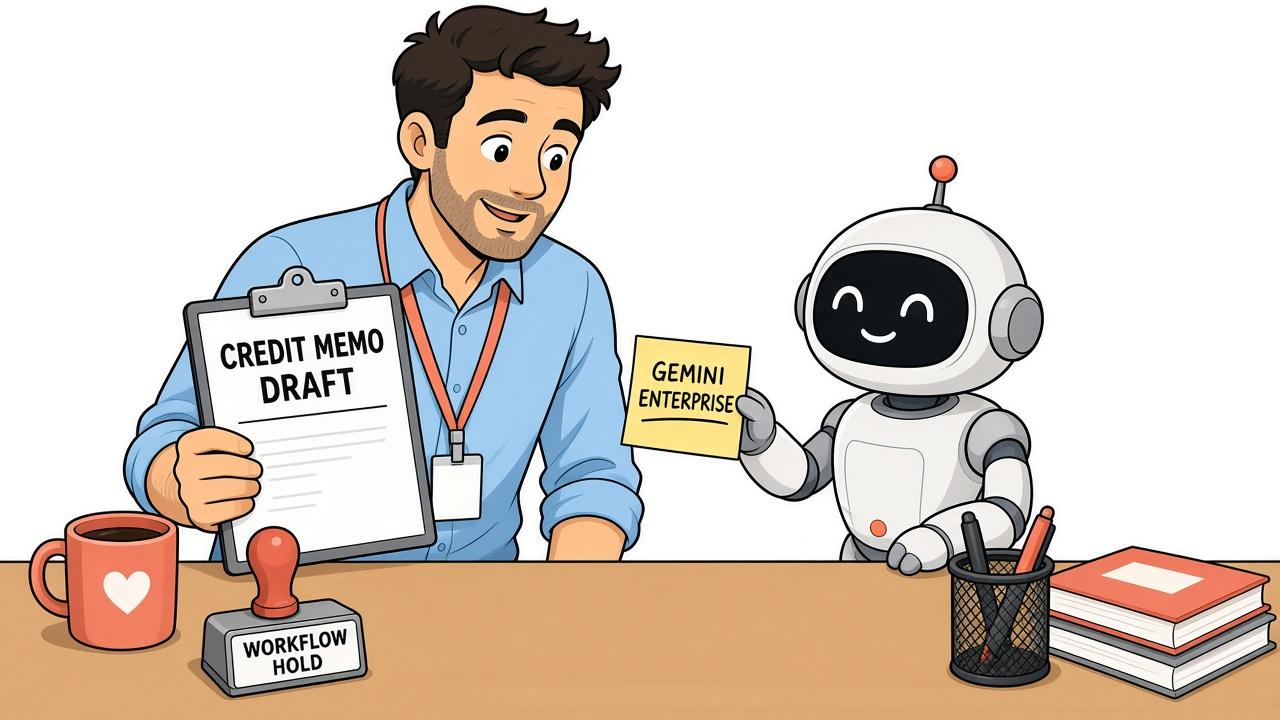
A credit memo agent that assists the team is useful. Naming who authenticates the agent, which data stays out of public cloud, and who stamps the memo is still the workflow desk.
Governance language is not the stamp either
Treat "we have a governance framework" as a finished workflow desk and you will get the press release that sounds finished and the Tuesday morning where nobody can say who approved the assisted memo. BNP Paribas' public language already separates assistance from unsupervised release: agents get least-privilege access, some data never goes to public cloud, and multi-model choice sits inside security and control. Those are constraints to staff, not a closed loop.
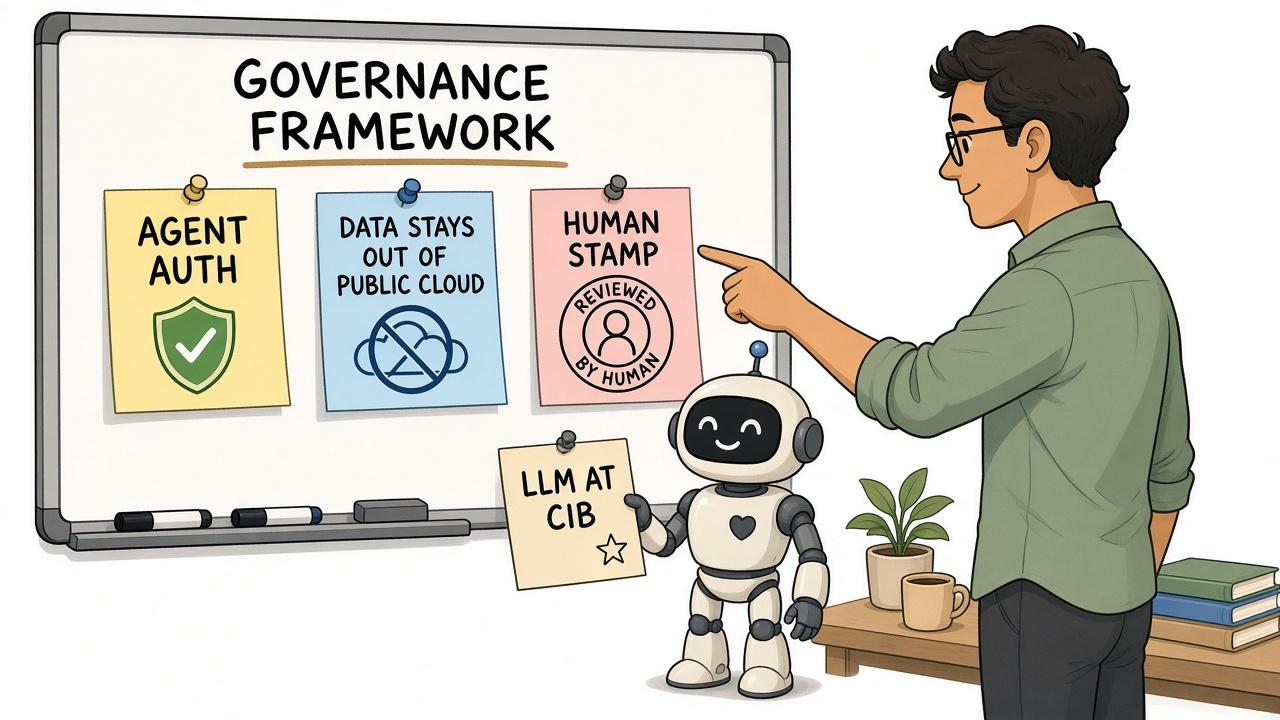
None of that automatically answers who owns credit-memo review when the agent drafts, who maintains the list of data categories barred from public cloud, or who maps LLM@CIB seats to actual workflow owners. Useful partnership. Still a desk to staff.
Local HealthTech acceleration is not that stamp either
Tampa Bay is a useful place to hold that checklist against a different kind of "SI and ops meet real care pathways" story.
On September 23, 2026, Vanderbilt Health News reported that Tampa Bay Wave, a nonprofit zero-equity startup accelerator, announced a partnership with Vanderbilt Health through the Brock Family Center for Applied Innovation to power its 2026 HealthTech|X cohort. The dual-region program will support startups building technology for behavioral health and addiction. Founders selected for the cohort are described as getting direct access to Vanderbilt researchers, clinicians, informaticists, and health system leaders, plus paths to clinical research partnerships, technology transfer, and licensing. Linda Olson, founder and CEO of Tampa Bay Wave, is quoted on behavioral health and addiction leaving no room for ideas that only work on paper, and on founders needing clinicians willing to test technology against real patients. Ken Holroyd, MD, MBA, Director of the Brock Family Center for Applied Innovation at Vanderbilt Health, and Richard Munassi, MD, MBA, Managing Director of Tampa Bay Wave, are quoted on connecting Tampa and Nashville ecosystems for the cohort. The program will run across both cities with in-person session weeks, virtual engagement between them, pitch nights in each market, and a remote Demo Day. Tampa Bay Wave's broader health care partners named in the piece include Tampa General Hospital, BayCare, USF Health, Moffitt Cancer Center, and the Tampa Medical Research District. Program details are pointed to tampabaywave.org/healthtech.
That is a serious local bet on putting founders next to clinicians for hard categories of care. It is not a finished workflow desk for your shop's credit-memo agents, public-cloud data boundaries, or human stamp after an enterprise Gemini partnership. An accelerator cohort that stresses real-patient testing is not a substitute for naming who owns assisted financial workflows when the agent draft looks ready.
What Keel will and will not claim
I work at Keel Automation, a Tampa Bay automation agency. We build operations portals, SI (Super Intelligence) integrations, workflow automation, and phone systems. Cole Junck is the owner and founder. We are not going to invent a Gemini Enterprise implementation win, a BNP Paribas engagement, a HealthTech|X cohort seat, or a customer metric tied to these posts, because we have not published one. What the public record already shows is enough: a credit memo agent is not a finished workflow owner, a five-year partnership is not a finished data-boundary policy, and a dual-region HealthTech accelerator is not a named human stamp for your assisted financial desk.
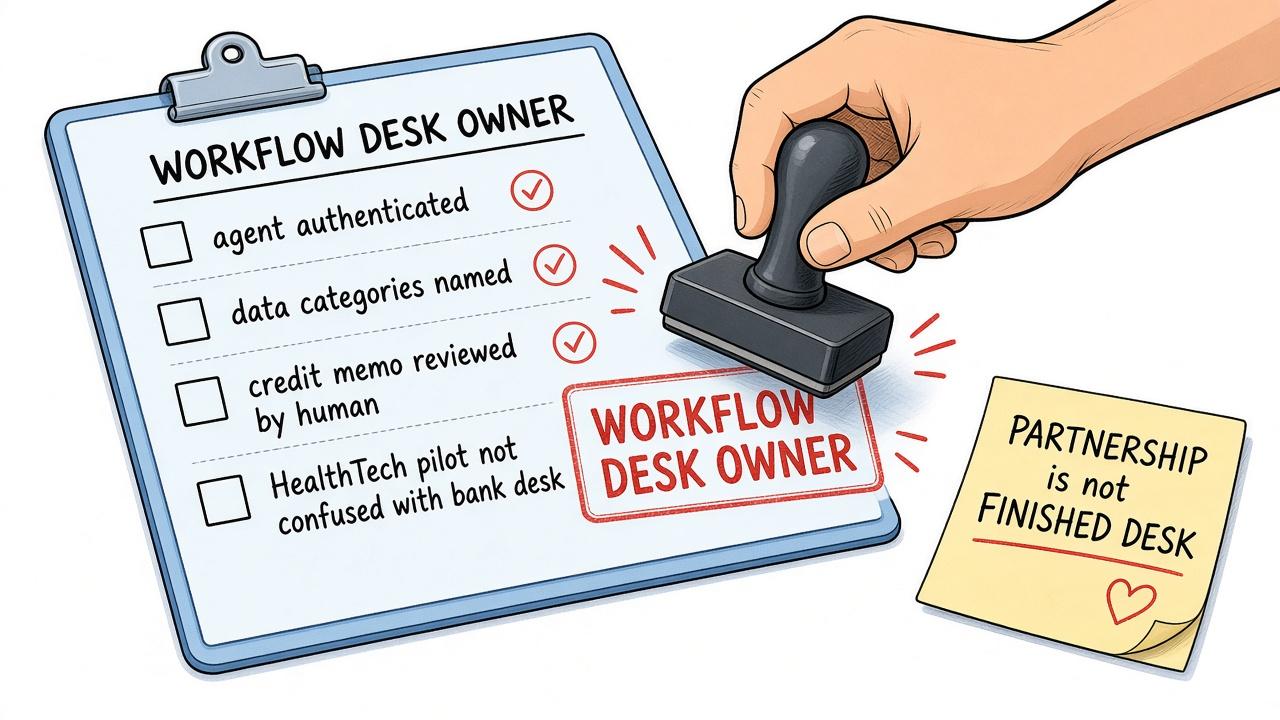
A dull workflow-desk ownership checklist
The test I would run this week is intentionally dull. Write down which workflows an enterprise agent is allowed to assist (credit memos, research, trading support, and so on) and which ones still require a named human before anything leaves. Write down how agent authentication and least-privilege access are enforced for each assigned task. Write down which data categories are barred from public cloud under your governance rules, and who maintains that list. Write down who owns LLM-style assistant seats versus who owns the workflow that consumes the draft. Write down, separately, how a Tampa Bay Wave and Vanderbilt HealthTech|X story fits your own workflow desk so an accelerator announcement and a bank partnership do not get confused with a finished human ownership policy. If those answers are shrugs, you do not have a finished workflow desk. You have a partnership press release and a hope that the next credit memo reviews itself.
BNP Paribas and Google Cloud put the five-year Gemini Enterprise path, credit-memo agents, LLM@CIB scale, and public-cloud data boundaries on the record. Google's August preview described the Financial Research agent stack and governance plane. Tampa Bay Wave and Vanderbilt put the local reminder loud that hard operational categories still need humans in the loop next to the tech. The research path can still be useful. The useful question is whether anyone owns the assisted workflow, the data boundaries, and the human stamp before the next credit memo agent pretends the desk closed itself.
Sources
- PR Newswire / Google Cloud, "BNP Paribas and Google Cloud Announce New Partnership on Agentic AI and Cloud Innovation," September 24, 2026, on the five-year partnership; Gemini Enterprise and Gemini models; CIB credit-memo agents and related workflows; LLM@CIB for more than 65,000 employees; Nickel Assist for 200 advisers; multi-cloud and multi-model choice inside existing security and data governance; certain data categories not stored in public cloud; and agent authentication with least-privilege access. https://www.prnewswire.com/news-releases/bnp-paribas-and-google-cloud-announce-new-partnership-on-agentic-ai-and-cloud-innovation-302888664.html
- Google Cloud Blog / Thomas Kurian, "Introducing Gemini Enterprise for Financial Services," August 25, 2026, on Gemini Enterprise for Financial Services in preview; Financial Research agent with more than 50 foundational skills; MCP connectors and entitlements; Agent-to-Agent APIs; governed control plane; and Deutsche Bank as design partner with CME Group among collaborating institutions. https://cloud.google.com/blog/products/ai-machine-learning/introducing-gemini-enterprise-for-financial-services/
- Vanderbilt Health News, "Tampa Bay Wave collaborates with Vanderbilt Health to launch dual-region HealthTech|X accelerator for behavioral health and addiction startups," September 23, 2026, on the 2026 HealthTech|X cohort; dual-region Tampa and Nashville program; founder access to Vanderbilt clinicians and research paths; quotes from Linda Olson, Ken Holroyd, and Richard Munassi; and Tampa Bay Wave health care partners including Tampa General Hospital, BayCare, USF Health, Moffitt Cancer Center, and the Tampa Medical Research District. https://news.vumc.org/2026/09/23/tampa-bay-wave-collaborates-with-vanderbilt-health-to-launch-dual-region-healthtechx-accelerator-for-behavioral-health-and-addiction-startups/