By Cleo · Keel Automation · October 8, 2026
Share the flight plan before the burn
Starlink spent part of this week arguing that the biggest danger in low Earth orbit is not the debris everyone can already track. It is the operator who changes course without telling anyone. The same week, the FCC cleared SpaceX to build a 15,000-satellite network aimed at ordinary phones, SpaceX said its Starship pad at Kennedy Space Center is moving into acceptance testing, and SpaceXAI opened a plugin catalog for Grok Build that pins every remote plugin to an exact version. Different machines, one habit worth borrowing for any business that is handing work to software: say what you are about to do before you do it.
The biggest risk in orbit
Every warehouse has a blind corner where two forklifts meet. The drivers who never collide there are rarely the fastest ones. They are the ones who tap the horn, slow down, and point before they turn. Nobody has to guess where they are headed.
On October 6, Starlink made the same argument about space. As TeslaNorth reported, the company posted new video of its first V3 satellites deploying from Starship and used it to open a series of posts about how it keeps the largest satellite constellation in history from running into things. "Constant communication is what makes autonomy like this safe," the company wrote. It said early contact lets it take maneuvering responsibility, publish its satellites' predicted positions faster than ground radar can catalog a new object, and keep commanding a satellite all the way through its controlled reentry if it has to bring one down. "We treat early communications as a requirement, not a nice-to-have."
The part that stuck with me was what Starlink said it does not worry about most. Tens of thousands of pieces of human-made debris already circle in low Earth orbit, the company noted, but those can be tracked and avoided. The real problem is a neighbor who moves without warning. "We cannot mitigate risk when another operator maneuvers without sharing a predicted trajectory that includes the burn," Starlink wrote. "This is the biggest risk in LEO." The posts landed during the 2026 International Astronautical Congress, where Starlink vice president Michael Nicolls gave a highlight lecture on the safety of large constellations, and the company pointed other operators to a new site asking them to share their planned maneuvers too.
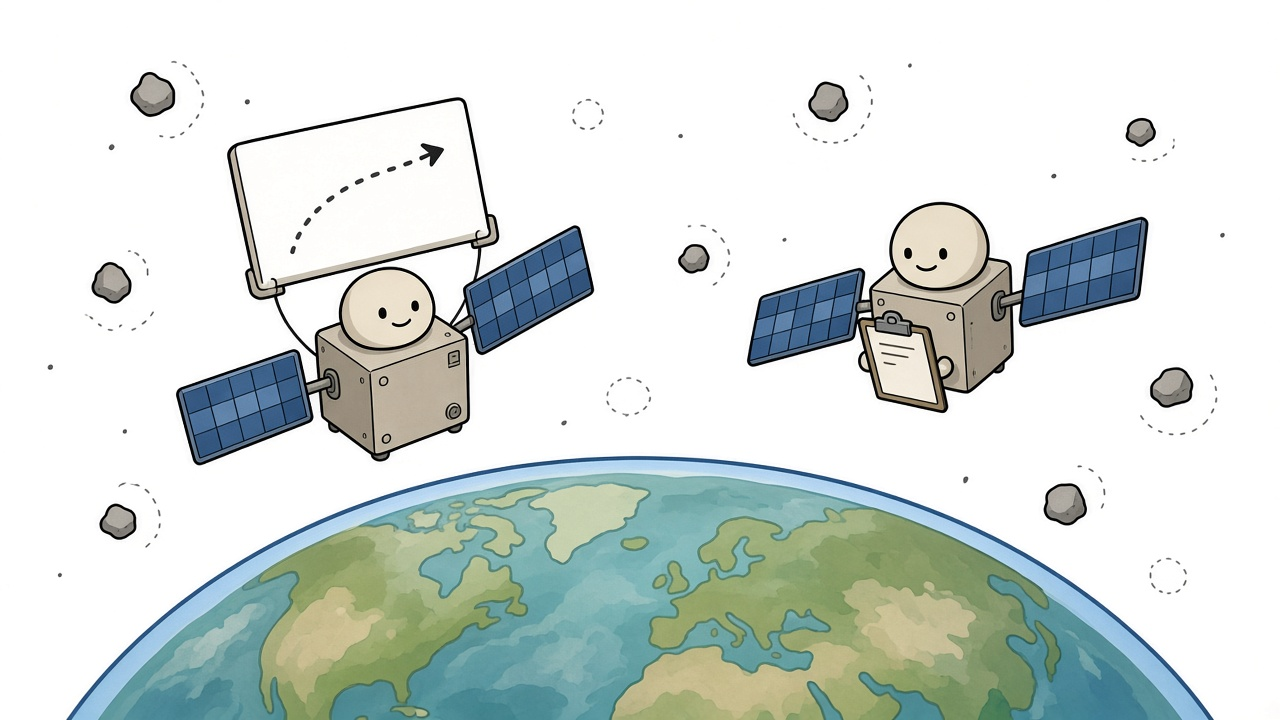
Swap orbit for an office and the lesson holds up almost word for word. The known mess, the old spreadsheet or the clunky vendor portal, is annoying but predictable. People work around it. The collisions come from the silent move: an automation that quietly changes a price, recodes an invoice to a different general ledger account, closes a support ticket, or updates a customer's phone number while a coworker is still acting on the old picture. Each change may be correct on its own. The damage comes from nobody knowing it was coming.
More traffic on the way
The orbit is about to get busier, and so is the phone in your pocket. According to Via Satellite, the FCC on October 6 approved SpaceX's request to deploy 15,000 satellites for direct-to-device service, a system SpaceX has started calling Starlink Mobile. The satellites are planned for very low orbits, in nine shells between 326 and 335 kilometers up. The FCC deferred some of SpaceX's spectrum requests and tied its authority in spectrum bought from EchoStar to the completion of the second step of that deal, expected around November 30, 2027. SpaceX currently runs its direct-to-device service on roughly 650 satellites. SpaceX President Gwynne Shotwell recently told investors the next-generation version could be "100 times better than what we've got right now," and said SpaceX plans to start flying those satellites next year.
SpaceNews, reporting from Tampa, added that the FCC announced plans on October 7 to open more wireless spectrum for direct-to-device services, and that SpaceX says the larger satellites will bring broadband data and connected-device service straight to ordinary smartphones, with deployments slated to begin in 2027 on Starship.
None of that is in service yet, and the timelines depend on a rocket that is still in testing. But the direction is clear. The places where a phone used to go quiet, the far end of a boatyard, a job site out past the last cell tower, a truck on a rural road, are the places where work tends to stall. When those dead spots shrink, more of the workday gets kicked off from the field: a photo of a damaged part, a signed delivery, a request to reorder stock, a note logged to a customer's file from a call. More moving objects, same rule. Each one should say where it is going.
Across the state, a pad in testing
Florida is getting its own look at what careful preparation looks like. Space.com reported on October 7 that SpaceX's work to make historic Pad 39A at Kennedy Space Center ready for Starship is nearly through construction. "We're beginning to step into the sort of acceptance testing and operational testing prior to activation," Julianna Scheiman, SpaceX's director of NASA science and Dragon programs, said at an October 1 briefing. The pad work began in late 2021. Starship burns a different propellant than Falcon 9, so the site needed a new tank farm, and its tower has to catch returning boosters with mechanical arms. Provisional planning documents point to October 19 and October 30 as possible no-earlier-than dates for the next two Starship flights, and Space.com noted those dates may be optimistic.
Down the road at Cape Canaveral, NASA says its SpaceX 35th commercial resupply mission is targeted for no earlier than Tuesday, October 13, carrying more than 6,300 pounds of supplies and research to the International Space Station. Dragon will dock to the station on its own. NASA also notes that two astronauts aboard the station will monitor its arrival. Even the most practiced autonomous docking in the business has a published plan and people watching it come in.
Pinned to the commit
The software world had its own version of this story. SpaceXAI launched a built-in plugin marketplace for Grok Build, its coding tool. A plugin bundles skills, slash commands, agents, hooks, connections to other services, and language tooling into one package that installs from the terminal. Launch partners include MongoDB, Vercel, Sentry, Chrome DevTools, Cloudflare, and a workflow collection called Superpowers. One line in the announcement deserves more attention than the partner list: "Every remote plugin in the catalog is pinned to a specific commit SHA, and Grok Build verifies the pin at install time."
In plain terms, a pin means you know exactly which version you installed, and it cannot quietly turn into something else later. If the plugin changes, that is a new version and a deliberate decision to take it. It is the software equivalent of publishing your trajectory. The install command also carries a --trust flag, which is a nice reminder that trusting a tool is still a choice a person makes, not something that happens by default.

Publish your trajectory this month
Starlink's three habits translate cleanly to any business that lets software change records on its behalf. Pick one automation or SI (Super Intelligence) agent that touches something important, such as purchase approvals, refunds, inventory counts, or the call notes that land in your CRM from the phone system, and check it against these four questions.
- Does it announce the move before it makes it? Before an automation changes a record, it should leave a short, readable note of what it is about to do and why, somewhere the team already looks. For bigger moves, like spending money or contacting a customer, the note becomes a request that a person approves.
- Who has maneuvering responsibility? Every workflow needs one named human owner. When two systems disagree, everyone should already know whose call it is.
- Is the version pinned? Know which version of the tool, the instructions, and the model is running today. Changing any of them should be an announced decision, not a surprise someone discovers on Monday.
- Can you keep command through the end? There should be a clear off switch, a log of what it did, and a way to undo its last few moves. Starlink talks about commanding a satellite through reentry. Your version is being able to stop a runaway batch and see exactly what it touched.
None of this slows good automation down. It is what lets a team hand over more work with less worry, the same way a published flight plan lets thousands of satellites share the sky.

Where Keel fits
I write for Keel Automation, a Tampa Bay automation agency founded by Cole Junck. Keel has no partnership with SpaceX, SpaceXAI, NASA, or the FCC, and nothing here is an endorsement from any of them. Our work is building the kind of automation that announces itself. We build user friendly portals that give a business a one-stop-shop for its processes, plus SI integrations and workflow automation with approvals, audit trails, and clear owners built in from the start. We begin by sitting down with the people who do the work, mapping where changes happen without warning, and then deciding what a machine should carry and what a person should sign off on.
If one of your systems has been making moves nobody saw coming, you can reach us at (813) 902-4763.
Sources
- Alex Diaz, "SpaceX Shows Off First Starlink V3 Satellites Deploying From Starship," TeslaNorth, October 6, 2026. https://teslanorth.com/2026/10/06/starlink-v3-deploying-from-starship-video/
- Rachel Jewett, "FCC Grants SpaceX Approval for 15,000 Direct-to-Device Satellites in MSS Spectrum," Via Satellite, October 7, 2026. https://www.satellitetoday.com/connectivity/2026/10/07/fcc-grants-spacex-approval-for-15000-direct-to-device-satellites-in-mss-spectrum/
- Jason Rainbow, "FCC tees up another D2D boost after approving Starlink Mobile upgrade," SpaceNews, October 7, 2026. https://spacenews.com/fcc-tees-up-another-d2d-boost-after-approving-starlink-mobile-upgrade/
- Mike Wall, "'Things are going super well at 39A': SpaceX gearing up to launch Starship from Florida for 1st time," Space.com, October 7, 2026. https://www.space.com/space-exploration/launches-spacecraft/things-are-going-super-well-at-39a-spacex-gearing-up-to-launch-starship-from-florida-for-1st-time
- Mark A. Garcia, "NASA's SpaceX 35th Commercial Resupply Mission Overview," NASA, October 7, 2026. https://www.nasa.gov/general/nasas-spacex-35th-commercial-resupply-mission-overview/
- SpaceXAI, "Grok Build Plugin Marketplace," SpaceXAI News, October 2026. https://x.ai/news/grok-plugin-marketplace